This year, Lunatick Racing finally ran some races as a real team, participating in the pair of AER races at NJMP, Lightning in June, and the one we had all been really looking forward to, the 14 Hour day/night race at Thunderbolt in November. For most of us, this was only our second experience with night racing, the first being the Devil in the Dark that we ran with NoRags Racing three years ago.
Team Members
For this race, we had one member who couldn’t join us (Dan Jensen), since he had already committed to driving with Team NoRags for this event before we planned it, but we were in neighboring garage bays and pit boxes, so he wasn’t too far away. We also had several new people join us, expanding the ranks of our group of racing friends. The roster for this race was:
Phillip Moore, driver
Brandon Fetch, driver
Robert Myles, driver
John Hainsworth, driver
Thomas Smith, driver
Peter McParland, crew chief
Jeff Yatsko, crew
Dutch Hurlbut, crew
Ivy Mamet, crew
Melissa Fetch, crew
Jean Myles, crew
Mark Patterson, crew
Cynthia Mosher, crew
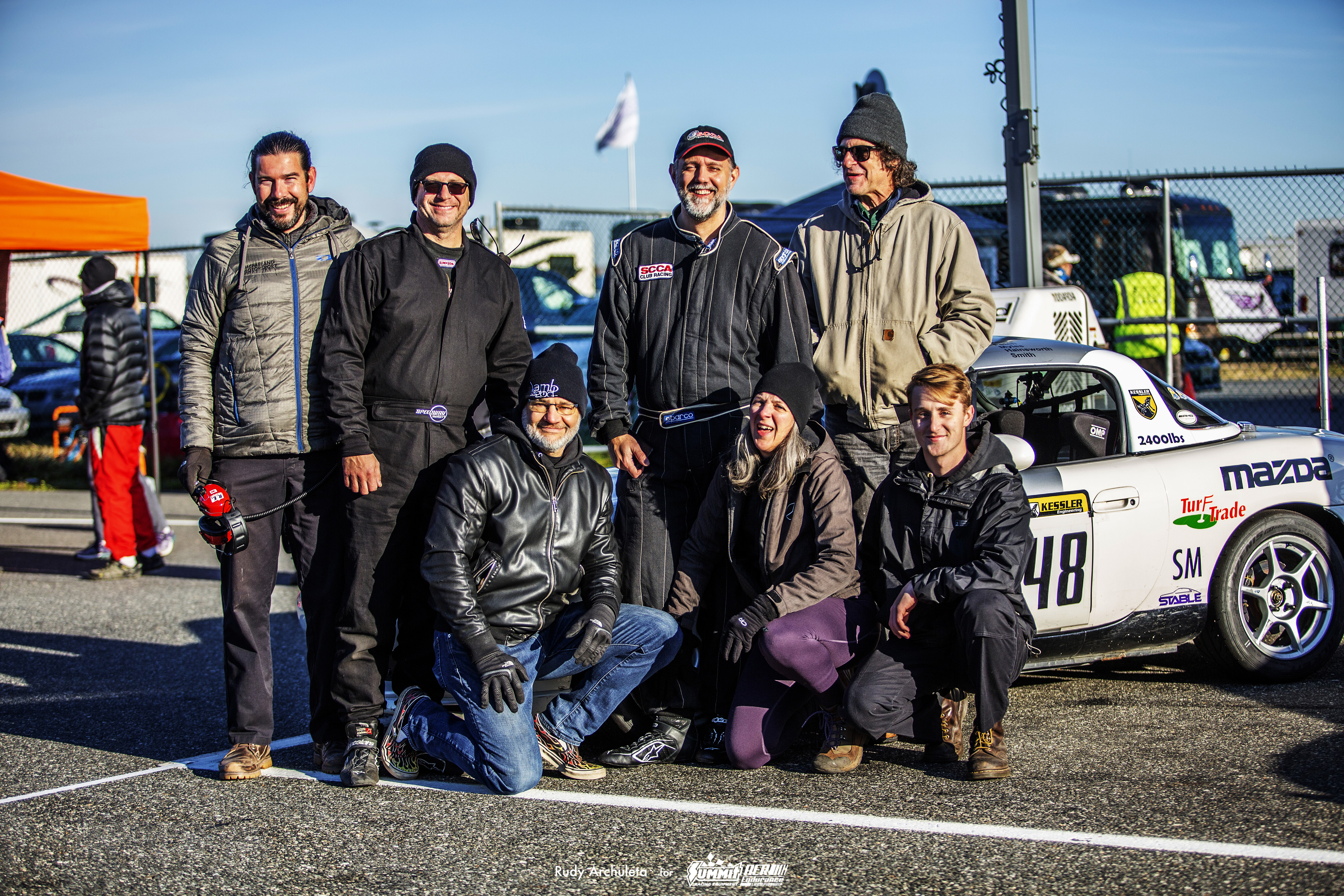
A subset of the team, just before the start of Saturday’s 14 hour race. L to R, top: Peter McParland, Jeff Yatsko, Brandon Fetch, Robert Myles. L to R, bottom: Phillip Moore, Melissa Fetch, Dutch Hurlbut
We had two new driver’s joining us (John Hainsworth and Thomas Smith), and we surrendered the critical decision making to a dedicated crew chief (Peter McParland). One new team member deserves special mention, as well. AER had contacted us to ask if we would be willing to take on a student from the Alfred State University Motorsports Program (from whom AER gets a lot of volunteer pit marshalls), and Brandon and I agreed to give Dutch Hurlbut a spot on the team. That turned out to be a great decision, as the young man (1/3 my age!) fit right in with the mostly middle aged racing geeks that make up the rest of the team. Dutch worked really well with our resident mechanical genius, Jeff Yatsko, and was a pleasure to have on the team.
Friday Qualifying and Night Practice
After unloading the car on Thursday night, we were able to spend a full day taking advantage of the time available on Friday. After Brandon drove a few leisurely laps scrubbing some new tires and bedding a new set of brake pads, we let John and Tom spend the rest of the morning practice sessions getting comfortable in the car, which was new to them. After lunch, everyone got in their required qualifying session, and we ended up starting 3rd, which was encouraging, since Brandon’s Miata is still tuned for SCCA Spec Miata, running with a restrictor plate which keeps us down on power relative to many of the other Class 1 cars. We put the car to bed confident that if we could run without any serious problems during the race, a podium finish was not unrealistic.
Of course, running a 14 hour endurance race “without any serious problems” is a bit of a pipe dream, so….
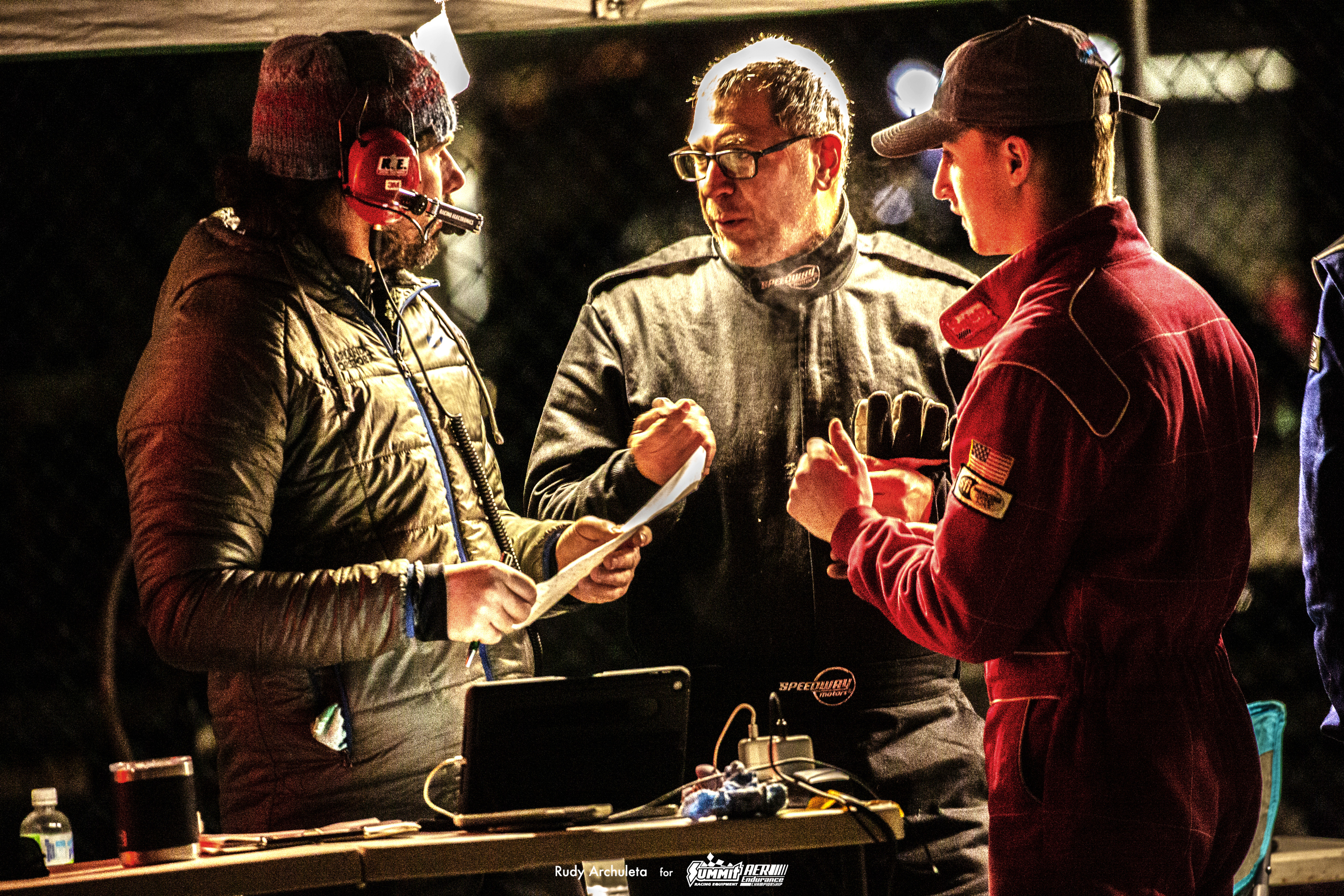
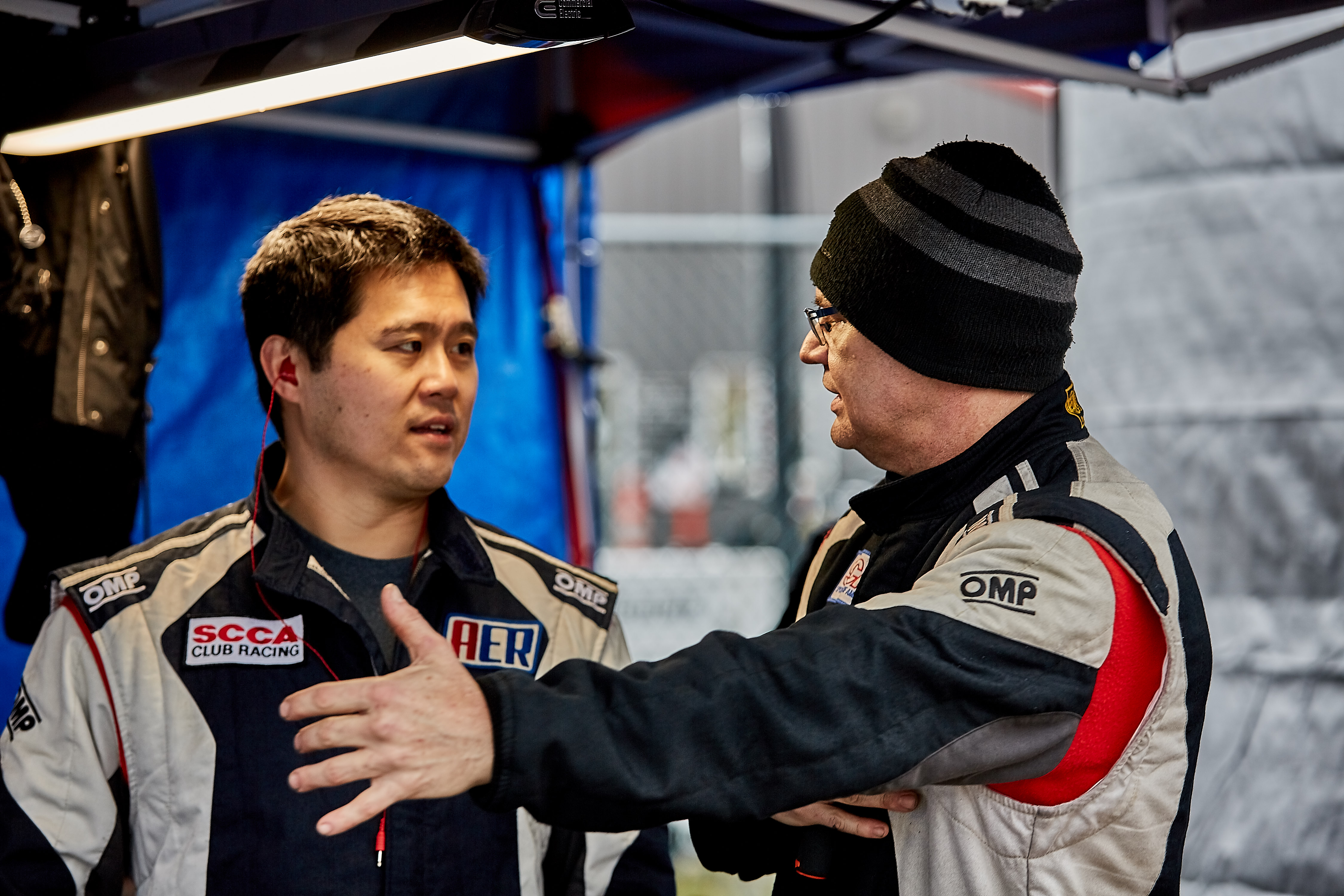
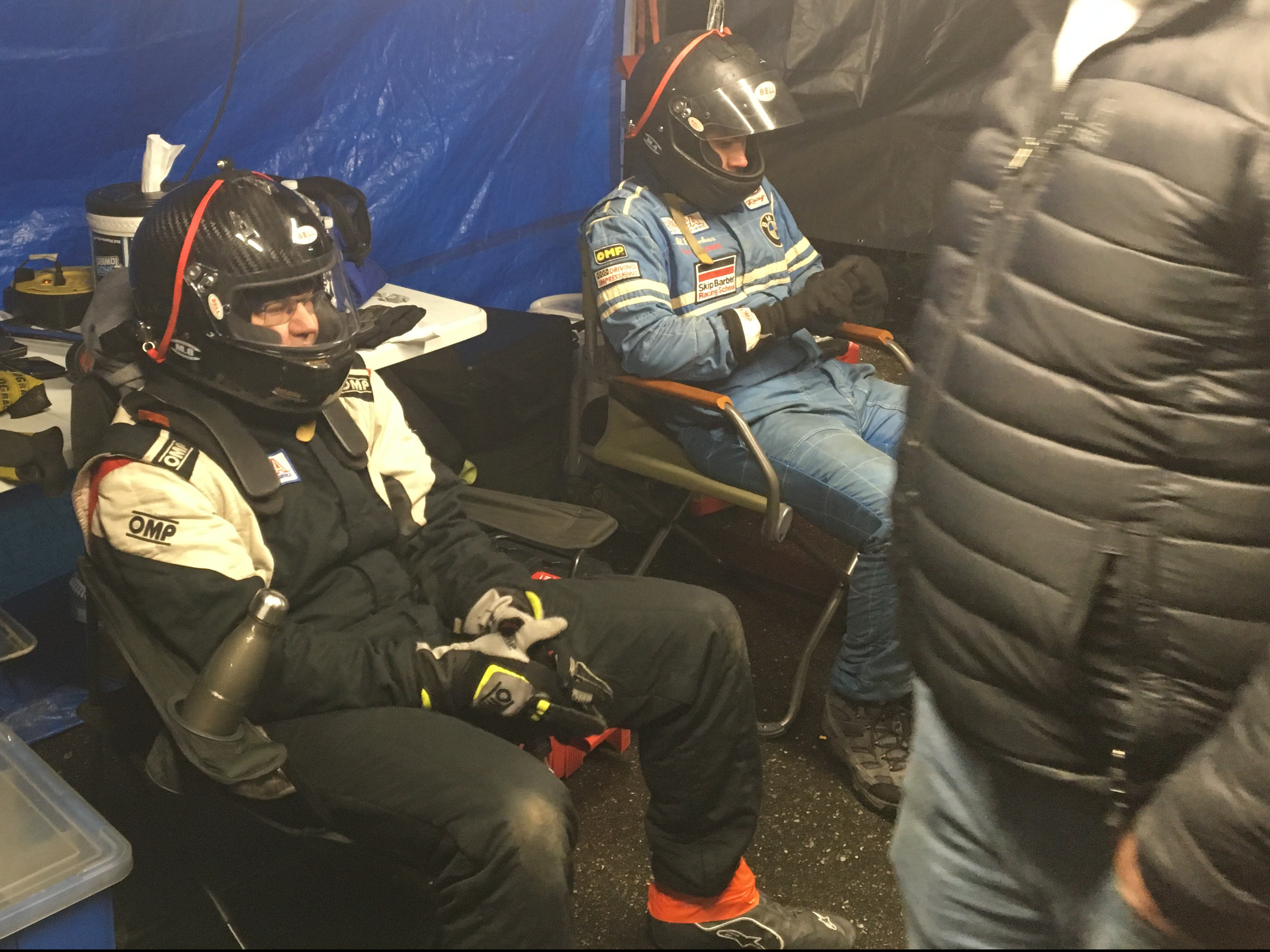
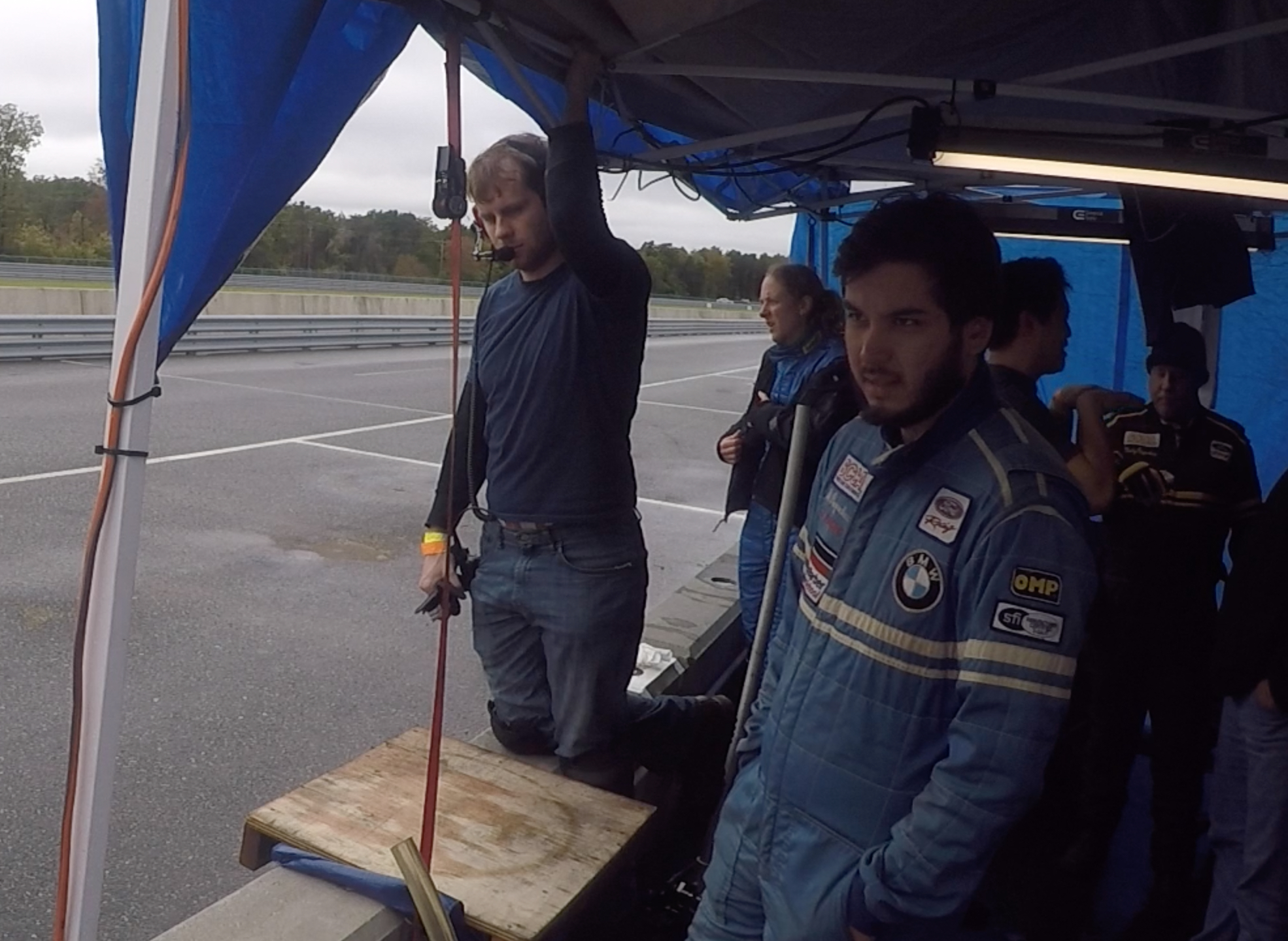
Peter, Jeff and Dutch discussing pit strategy during what was a cold, but thankfully dry, night
Saturday Race
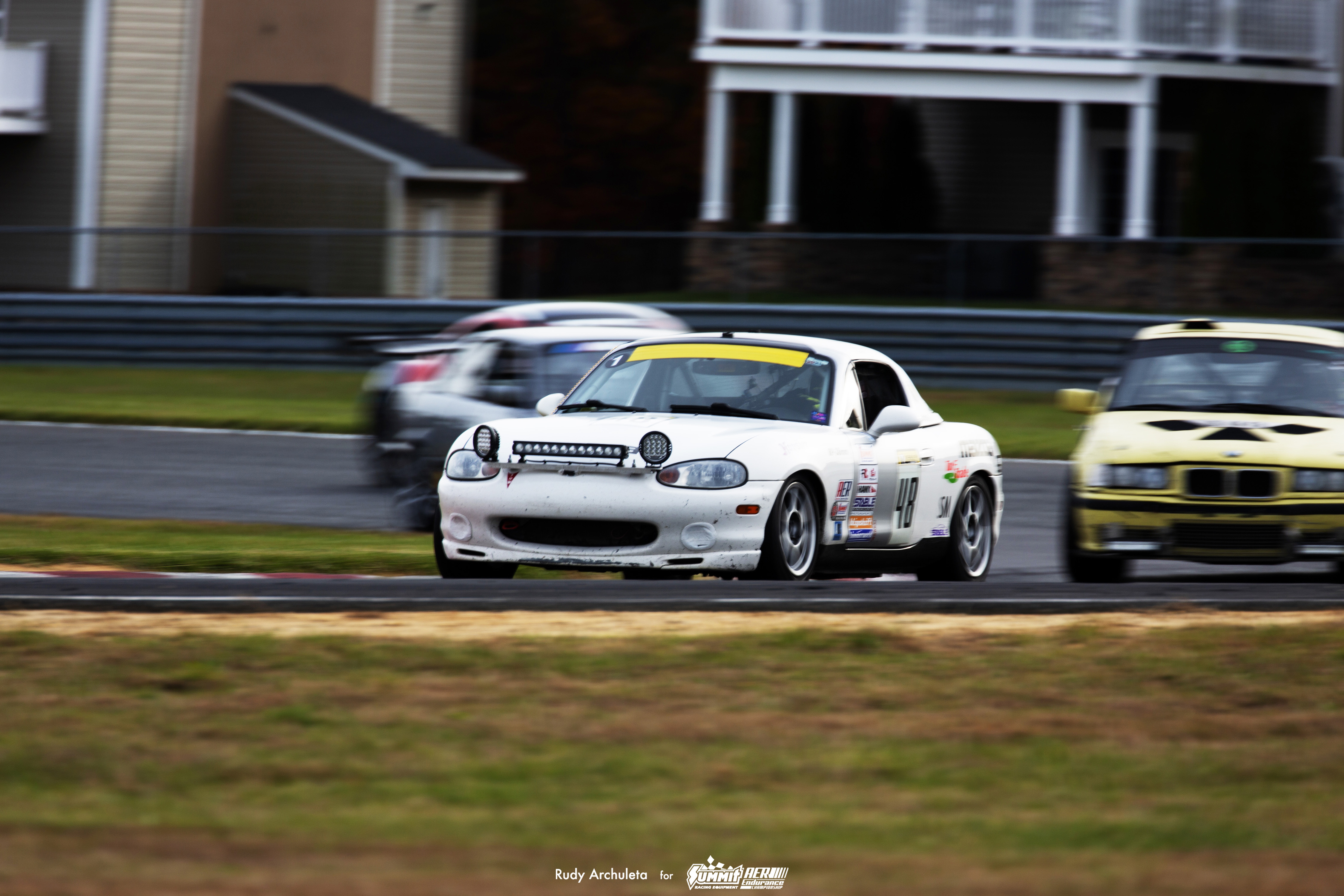
We let Peter do his job as crew chief and set the rotation, with the caveat that we wanted Brandon to start the race, since we set him up as the finisher at the June race at Lightning, where due to a variety of problems, he never ended up in the car. After Brandon, the rest of the order was Tom, Robert, Phil and then John. Brandon’s opening stint went well until near the end when he radioed in that the car was starting to run rough at RPMs below the power band. Thus we began what would end up being a rough total of nearly 2 hours of the race spent in the garage trouble shooting a performance problem. Tom, Robert and myself all struggled with the car’s performance during our stints, with the car running rough and down on power if you made the mistake of letting the RPMs drop below about 4000.
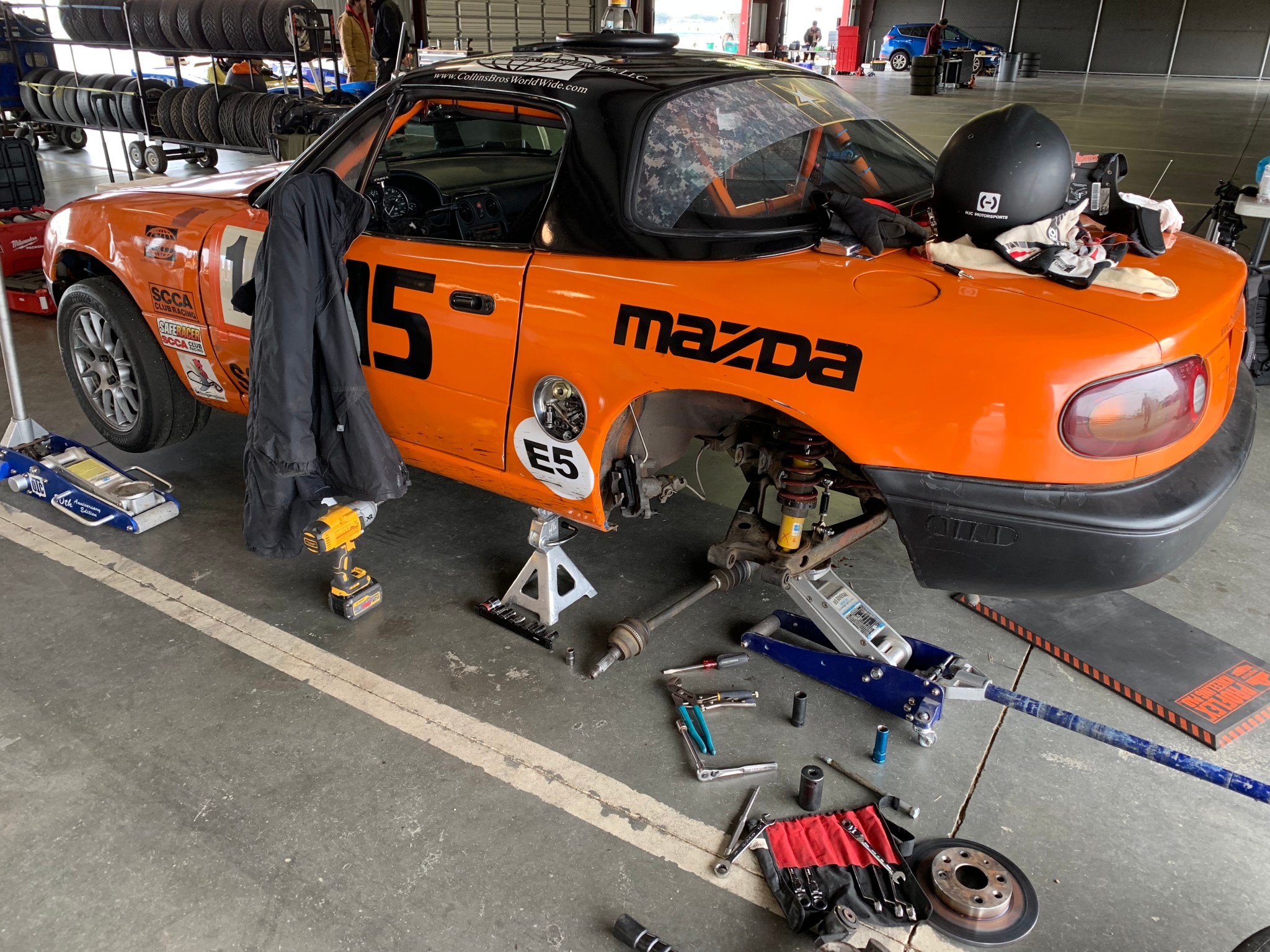
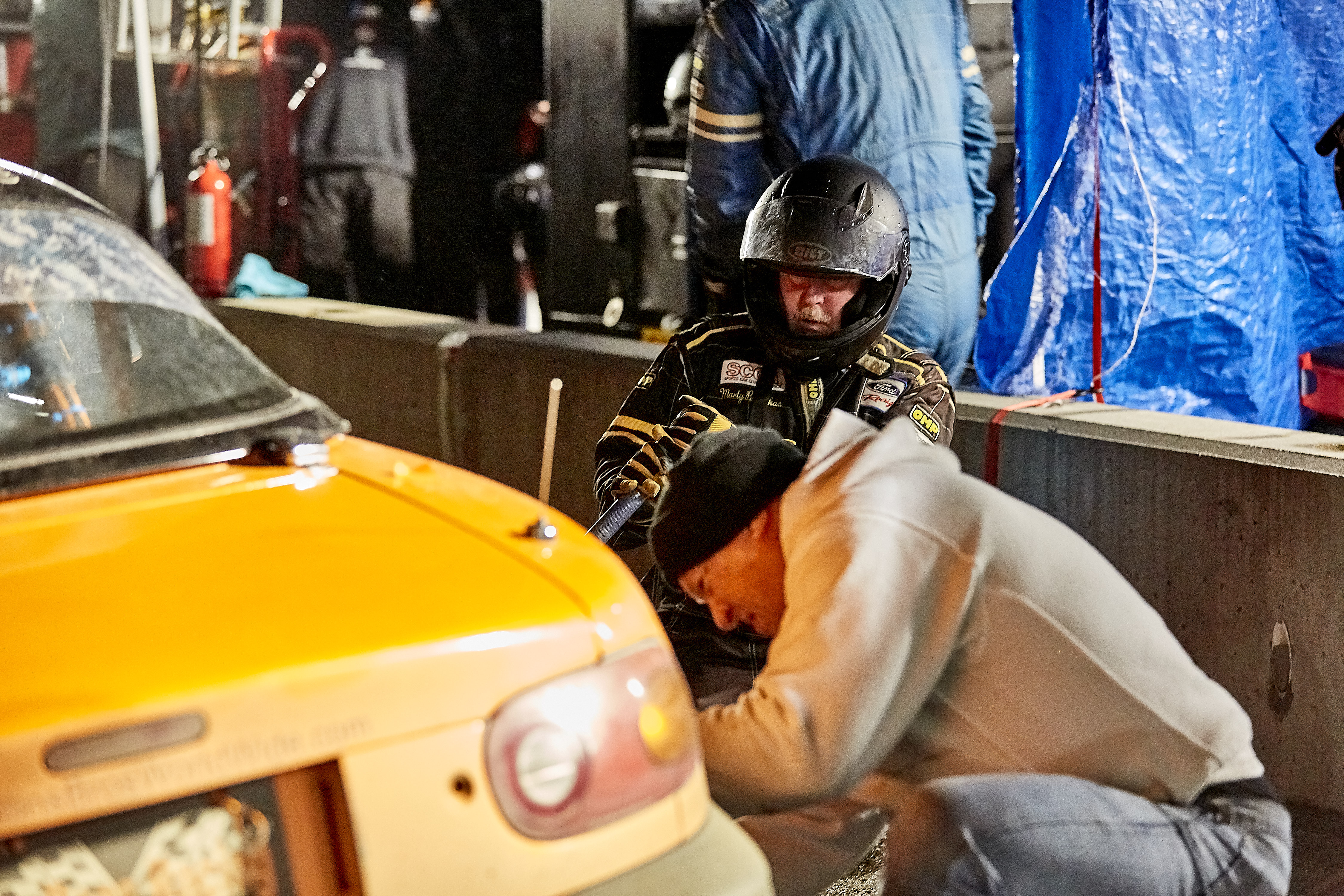
Towards the end of first John’s stint things got worse, and we spent nearly an hour aggressively trying to resolve the problem, changing plug wires, plugs, the cam sensor, and finally the coil pack, which restored the car to normal behavior. This was a great team effort, which also included changing out the right rear upright, which was found to be failing during one of the short runs we made testing out one of our attempts at a performance fix.
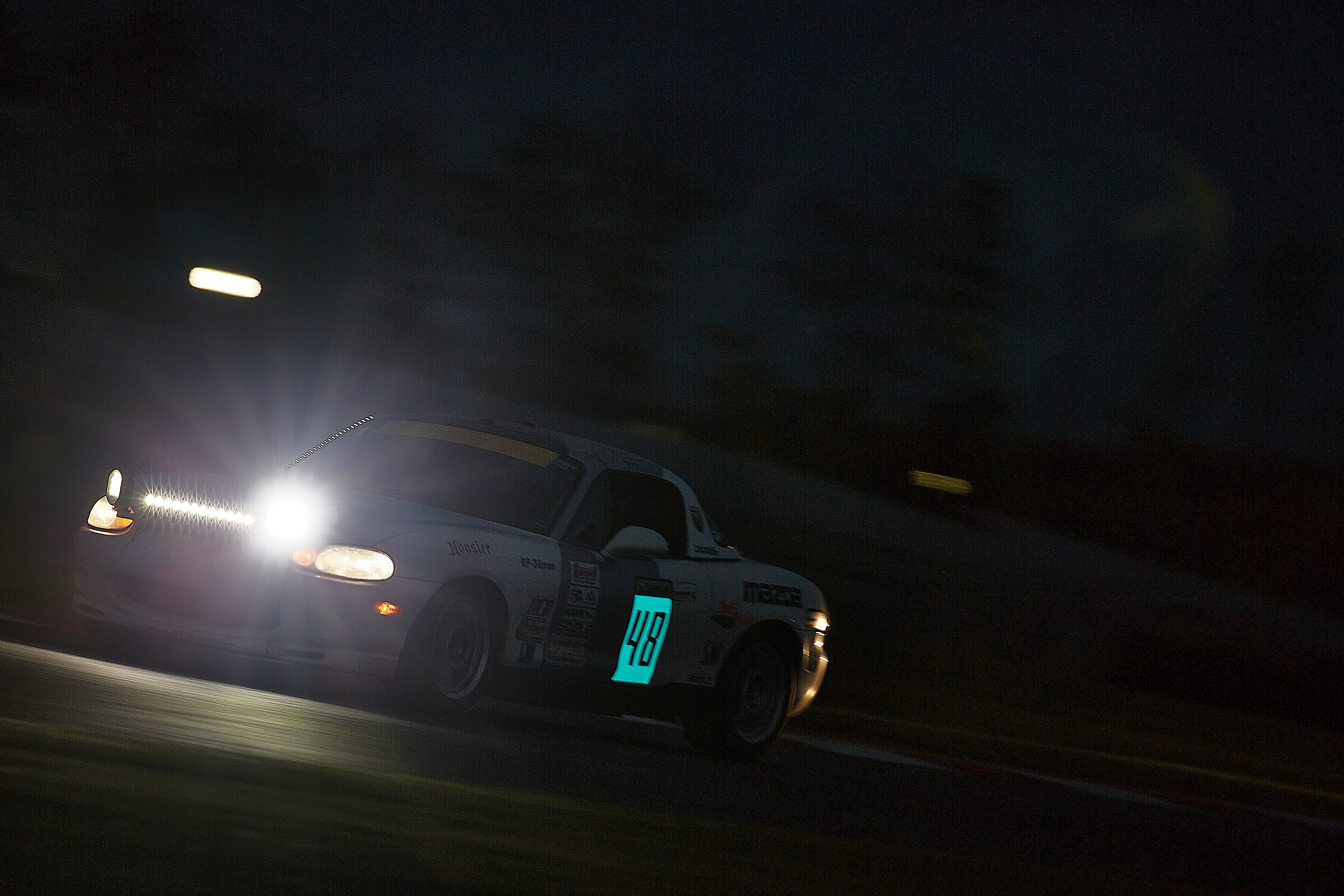
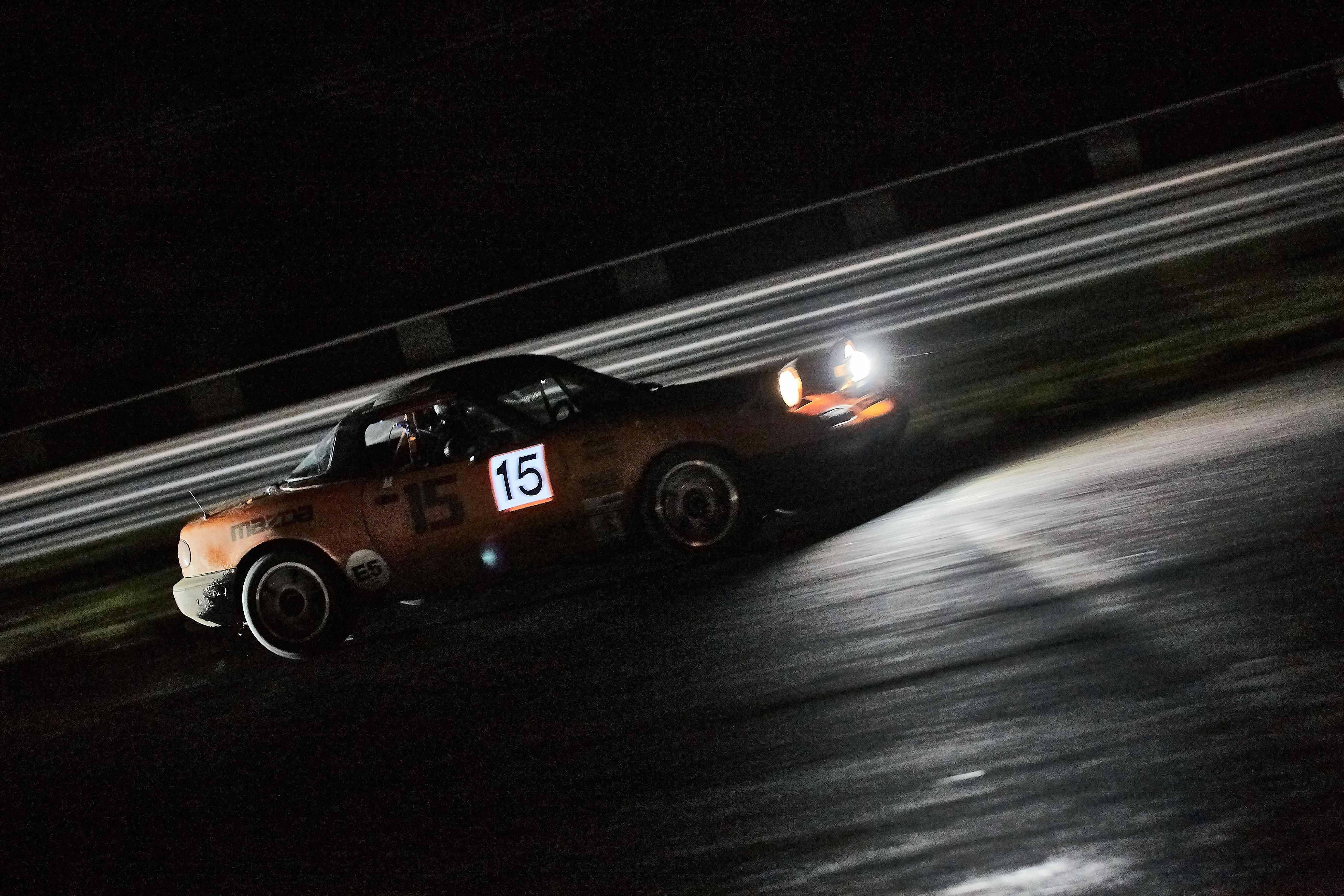
Night racing has to be one of the most thrilling on-track experiences I’ve ever had, and I really wish there were more opportunities for it in the amateur endurance racing world.
With the car’s performance restored, we ran the rest of the night without serious issues, other than losing the rear view mirror, which popped out and broke during my second stint. The last five night stints went very well, and we ended up finishing 7th out of the 12 Class 1 cars that started the race. While we obviously wanted a trophy, finishing the race strong after dealing with a number of major problems was itself an accomplishment, and the end of the weekend, everyone had an absolute blast, and I am personally looking forward to racing again with this team of friends.
Lunatick Racing will be back in 2022, running in at least four of the scheduled AER races, if at all possible.
Driver’s Stint Videos
The following links are the minimally edited in-car videos for each driver’s stints.
Ever since I first discovered sports car racing, or more specifically, discovered that you didn’t need to be Bill Gates to own a race car, I’ve been drawn to endurance racing. Until last month, however, I had only had the pleasure of driving in sprint races, and had limited experience driving the car for longer than 30-45 minutes at a time. All of that changed when we managed to put together, at about the last possible date, an impromptu team for the 12 hour Devil in the Dark endurance race at NJMP Thunderbolt.
This year’s race was jointly sponsored by both the NNJ and SNJ regions of the SCCA. Full disclosure: both Brandon and I are on the Board of Trustees of the NNJ region (Brandon’s the Regional Executive), and we were strong supporters of the idea, since our region didn’t get our usual race weekend at Pocono this year, thanks to a scheduling snafu with NASCAR.
For this race, Team NoRags (normally the partnership of team and car owner Marty Raguckas and Steve Noake) was composed of:
Marty Raguckas, driver
Brandon Fetch, driver
Phillip Moore (AKA: the lunatick), driver
Dan Jensen, driver
Michael Qiao, driver
Melissa Fetch, crew
Mike Hontz, crew
Kentaro Moore, crew
We were driving Marty’s SSM prepped 1989 Miata, although by the time we were done with it, it was closer to the SM2 spec. Over a couple of weekends prior to the race, and far more evenings that anyone had planned, we installed my VBox HD2 video/data system, Marty’s AIM Solo2, did a full season prep on the car, upgraded the electrical system, as well as countless other little improvements.
Michael Qiao and I discussing something subtle about endurance racing, I’m sure. I learned a lot from Mike and Dan, both of whom have a lot more enduro experience that myself.
Among the five drivers, we had three with significant enduro experience (Marty, Brandon and Mike), but two who were about to drive in their first (Dan and I). With the car able to run a bit over two hours on a full tank we figured we had about six stints to run. The crew members were Melissa (Brandon’s partner in life as well as racing), who acted as the team’s representative with the officials, worked the radios, and like everyone else did about a 100 other little things. Mike Hontz, a navy veteran and therefore the team’s resident prankster and insult expert, worked as our fueler for most of the pit stops, and also handled some of the Pit Watcher volunteer duties every team was responsible for. Finally, my son Kentaro also got to work as the fueler and split the Pit Watcher duties with MikeH, while he got his first experience at a road race.
Test Day
I decided to be cheap, and save one night in the hotel by driving down early Friday morning, which meant waking up at 5AM, and I ended up rolling into the paddock at around 7:30. Brandon was just getting the car unloaded, and we spent the morning setting up the garage and doing some last minute tinkering with the car. They let us onto pit lane a bit before noon, and we set up our tarp-covered popup tent, which would keep us out of the horrid weather that was headed our way the next day.
Marty took the car out first, and ran some pretty good laps, and then Brandon hopped in. Unfortunately, he got black flagged for smoke, which was initially thought to be tire rub, and instead was gear oil leaking from the left side axle seal on the diff. After wasting some time on hold with just about every auto parts store near NJMP, we scored a seal from Nick Leverone of Flatout Motorsports (not the first time they’ve bailed me out with Miata parts, either), and we got to work replacing it. Mike Hontz crawled under the car and did most of this work, but like everything we did, it was a team effort.
Team NoRags lost about 30 minutes of the first open test session replacing the left side axle seal on the differential. Had the right side started to leak, it wouldn’t have dripped oil onto the exhaust, and we might not have discovered it until it failed during the race.
Once we had the car reassembled, Brandon made another run, and then Dan and I got turns getting used to the car. Slightly down on power from my 1991 SM2, and with the rear sway bar set to full soft, the car was a lot looser than I’m used to, but I got accustomed to it pretty quickly. One thing I learned was that getting a tail-happy car around the dreaded octopus turn was a lot easier than a neutral car like mine. Dan adapted to it a lot faster, though, and was running almost two seconds faster than I was in the dry. I had some catching up to do.
Here’s a set of links to all of our practice runs:
After a break, and a practice session we ended up skipping, Brandon went out in the qualifying session and ran a 1:39.575, putting Team NoRags on the E5 pole. Here’s the video of Brandon’s qualifying run:
The last sessions of the day were the two 30 minute night practice sessions, and since the planned driver rotation was: Marty, Mike, Brandon, Dan, myself and then Brandon again, the last 3 drivers all got time in the dark. Dan’s stint was going to start light and end dark, and he went first, then handed the car over to me. Brandon ran the last session, and then we put the car to bed after a quick oil change.
It was right around the start of the first night practice that the weather started to really turn, as a fairly major rain storm was sweeping through the area, the storm that would make race day wet, cold, and nasty, from start to finish. This led to some adventures on track for me, as I went out on slicks, only to find out how little grip they had. Now, I have two360 spins on video. After running about half my session sliding all over the place, I came in and got rain tires. We were also starting to struggle with the radios, as one of the headsets had a shorted button.
As the night wound down, my son Kentaro showed up for what was going to be his first taste of road racing culture. I hadn’t exactly made it a very big secret, but I was hoping he would catch the bug. This was his first time at a race track, and he was looking forward to crewing with us, and seeing why his father was blowing his possible inheritance here. I’ll have more to say on this later…
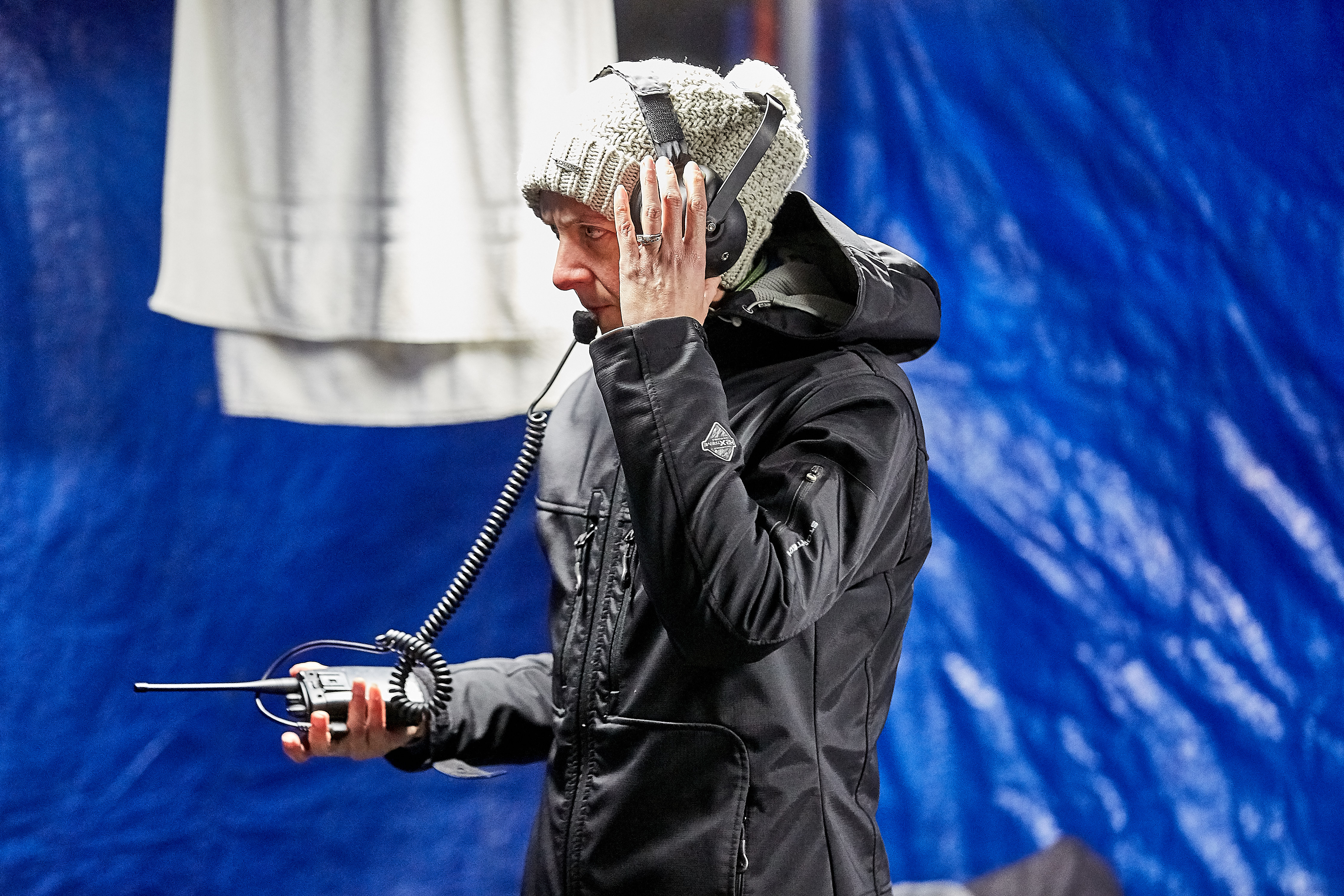
Melissa Fetch looking very serious monitoring the radio. She gets credit for discovering that the hand warmers we bought could be used in pairs to restore feeling to your nose.
Race Day
We all got to the track before 8 AM, and started to get ready for the race. We got the car fully fueled, and the tires all carted out to pit lane, but only after spending a half hour fixing our pit lane tarp. We had tied everything down pretty well, but the winds over night had just about destroyed a few of the other team’s setups, and ours fared pretty well. One additional tarp and another 100 zip ties or so (I buy them in 500 count bags), and we were ready to go.
Green flag was at 10:30, and the rain was a steady drizzle, with standing water in places on the track, and the totally saturated ground off course had started to soften and turn to mud. This would be a major factor in the race through out the day. We got Marty to the grid on time, and the cars all got staged, only to be told the start was delayed by 15 minutes. I’m not sure why, because it certainly wasn’t to wait for the weather to clear up.
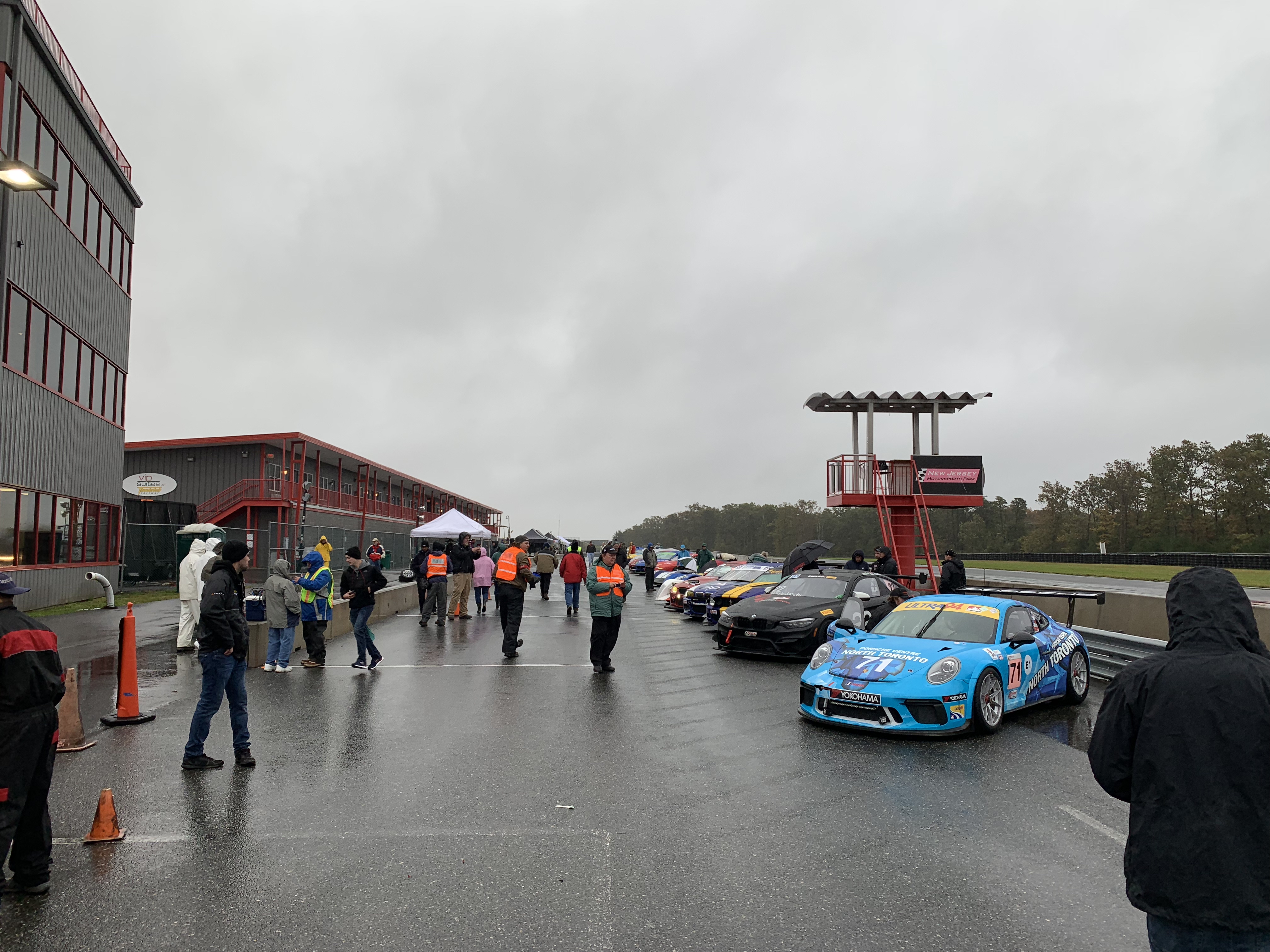
A few minutes before rolling out for the green flag, driver’s are in their cars, and ready to go. The start was delayed 15 minutes, and the weather was a constant drizzle and mist all day.
The whistle finally blew, and one by one, the field rolled out onto the track, and this was the moment when I realized… we had forgotten (well, I had forgotten, since it was my job) to start the video system recording. As we saw Marty rolling down pit lane, we considered bringing him in to the bit box, but then we would have had to start at the back. An effective no-decision meant he kept on rolling, and we wouldn’t get video of Marty’s run until a black flag all brought the entire field onto pit lane for some cleanup, when we had Dan sneak down to presumably give Marty some water, only to reach in and hit record. Technically, this was cheating, ’cause you’re not supposed to touch or work on the cars during a stoppage like this. Sue us….
[[ Note: does this tidbit of cheating qualify us for the Spec Miata Man Drama facebook page!? Probably not… we’re gonna have to cheat harder than that… ]]
Here’s the video clip of the cars rolling off pit lane, and me realizing how badly I screwed up…
I climbed the five flights of stairs to get on top of the timing and scoring tower, which is a fantastic view where you can see the entire course, in all of it’s soaking wet and slippery glory. Here’s the shot of the start of the race:
From the top of the tower, you could see that in the first few laps, cars were going off track all over the place. There was standing water in some of the turns, in particular the braking zones, and it wasn’t long before there was too much carnage on track for the workers to safely hot pull everything, and we had the first and only black flag all of the race. Amazingly, while we had a lot of full course cautions throughout the night, that was the only time they cleared the track. This was, as noted above, a convenience for us, as we got the video system running, and recorded the rest of Marty’s stint.
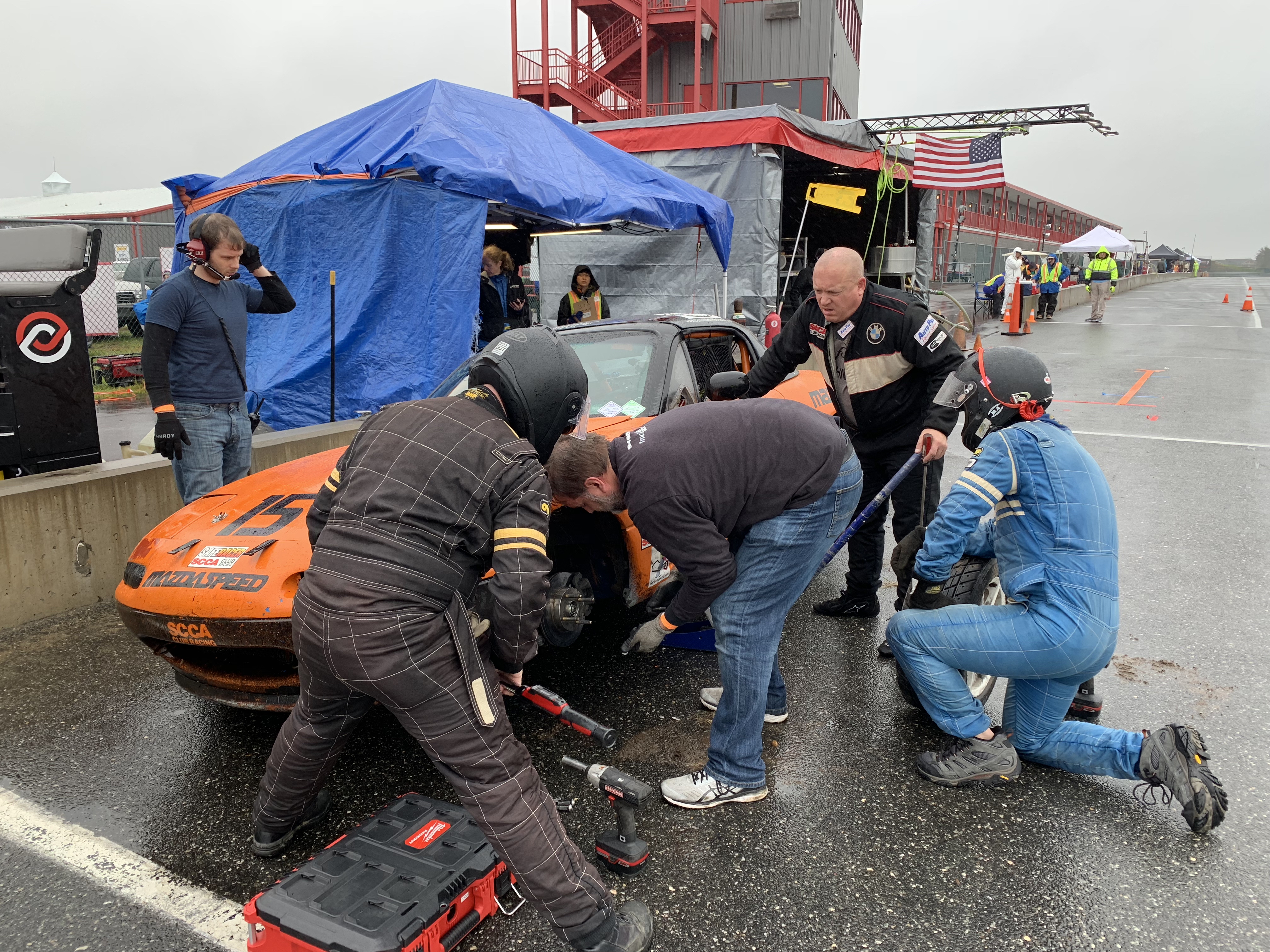
Just over a half hour later, Marty came in earlier than expected after some contact on track that resulted in significant damage to the front left corner, and he was experiencing a pretty violent vibration. We pulled the wheel off, and initially concluded that we’d lost the hub, and we pulled off a swap in less than 10 minutes.
Team NoRags working on an emergency front left hub swap. It would turn out that this probably wasn’t the cause of the vibration, and it would take a second pit stop to figure out that it was actually a loose lower ball joint bolt. L to R: Dan Jensen, Mike Hontz, Brandon Fetch, Marty Raguckas, and Kentaro Moore
Although it was a bit earlier than planned, we went ahead with the driver swap and put Michael Qiao into the car. Mike was the last driver we had recruited for this, and he wasn’t able to join us for the entire event, but his experience in AER, and his very recent experience driving Thunderbolt in the rain was a huge advantage. Mike immediately reported the car still had a significant vibration, and when it didn’t shake out after a few laps, he came in and Brandon found the loose lower ball joint bolt. Once that was tightened up, the problem was gone, and Mike ran the rest of his stint without any further drama. Unfortunately, for reasons I have not had time to figure out, the data system failed to record anything on the USB stick we swapped in, so we didn’t get to add to Mike’s extensive collection of videos.
Mike’s stint was pretty uneventful, and when he came in, it was Brandon’s turn for his first stint. We had originally said we would draw straws to see who got the second stint, but I argued it belonged to Brandon, because no one on the team put more hours, and more of his own money, into prepping the car and getting it ready for the event. He more than earned the right to drive twice, and besides that, he’s the fastest driver on the team.
This was the first pit stop where I remembered I had a GoPro mounted on a tripod in pit lane, and we got this video of the Mike to Brandon driver change. We had planned on swapping the rain tires, but Mike convinced Brandon while we were fueling that the replacements were no better, and we bailed on the tire change. Honestly, the pit stops were the highlight of the event for me, since this was the first time I’d ever experienced this aspect of road racing, and it was a ton of fun.
The battery on the car had died on us, and we were forced to resort to push starting the car. This was the beginning of the wave of electrical problems that would hound us throughout the rest of the race, and almost turned my stint into a somewhat embarrassing comedy of errors and stupidity on my part (I’ll get to that, I promise). For reasons I also can’t figure out, the video system didn’t start recording Brandon’s session when he left pit lane, but the data and video started in the middle of a lap. I have some theories, but until I get my data system out of Marty’s car (which is currently parked in his trailer in Eastern PA), I won’t be able to test any of them.
Brandon ran a great stint, and actually put down the 10th fastest lap of the entire race at 1:49.490. Rain truly is the great equalizer, because the GT3 Cup Car that led the entire race and won overall only put down a 1:39.816 as the fastest of the entire race. Here’s the video:
The first of several very well timed (for us) full course cautions fell as Brandon was nearing the end of his first stint, so we brought him in for the driver change to Dan. This pit stop was our busiest, and our best, as we had to change all four tires to a newer set of rains, check and top off the oil, as well as install the extra lights on the front of the car. I failed to record this from the pit stop camera, but after the problems we had with the memory stick in the data system during Mike’s run, I decided not to swap it out, since the other USB sticks obviously had some issues. As a result, we got the entire stop from the internal cameras:
Dan’s stint was the one that spans the sunset, and conditions stayed very wet as he went from daylight to night, and unfortunately, our electrical problems started to get serious. Dan reported that the car would sputter around 6K rpm, and the lights were flickering as well, but he endured, and ran the single longest uninterrupted stint of the race, at well over two hours. He had a few adventures on track as well, but brought the car back to pit lane in one piece, where I was waiting to hop in for my stint. Here’s the full video of Dan’s stint:
Phil’s Stint: the Dipshit in the (near total) Dark
Finally, it was my turn to hop in the car, and from the moment we tried to fire it up, things took a turn for the worse. We could NOT get the radios to work, and the data system again refused to record with the replacement USB stick, so I had no video (although I could at least track my lap times on the AIM Solo2, which gave me a rough idea of how long I was out there), and I could NOT communicate with my pit crew.
Me, getting my game face on, trying to quiet the butterflies, while Ken waits to work on the fueling team. The orange duct tape on my left shoe was an emergency repair required when the damn strap snapped off. Further evidence of the infinite possibilities of duct tape.
Initially, the lights came on when I left pit lane, but they sure as hell weren’t very bright. I was also suffering the sputtering at 6K that Dan had reported for the first few laps, but that just suddenly stopped, and that was also the point where I think the lights went out. Yes, the lights went OUT, but I didn’t realize it because I ran with a few other cars, and was actually driving in THEIR lights, not mine. As soon as I was alone, I realized that the glow from the front of my car was pathetic, and it was extremely difficult to see where I was going.
This is the point where I thought I should pit to get things working again…. and then I passed the E5 leader, who was himself sputtering along, clearly suffering from a mechanical problem, engine making some very unhealthy noises as a drove by. OK, so now I had a judgment call to make. Yes, it was hard to see (I am pretty sure the halogens were *OFF*, and I had nothing more than the running lights to help me see where I was going). So, my initial decision was: I’m getting laps back, just suffer and keep going.
Mike Hontz watching Marty Raguckas force the last lug nut onto the back right wheel. It was stripped, but we couldn’t leave pit lane without all 4, so he leaned into the impact gun until it was on. Getting that wheel off is not going to be any fun….
Now I have to admit I’m kinda glad I don’t have this on video, because everyone on pit lane is watching me drive by WITH NO LIGHTS ON, so they tried to get me to pit. And, I, um… er… didn’t see them. Marty walked out to the far pit wall and tried to flag me down, but I just didn’t see him. They even asked race control to meatball me, and they did, but I could NOT see them doing so in the dark. That’s on me, and not one of my proudest moments as a driver.
Finally, Marty stood there on the wall violently waving our #15 pit board sign, I saw him this time, and came in the next time around. After we shut the car off and restarted it twice (electrically… we still had to push start it to get the engine turned over), for whatever reason the damn lights came on bright as hell. One minor victory against the electrical demons (who would have the last laugh).
It’s so much better to drive at night with your lights on….
Frustrated and pissed off (at myself, mostly), I went out there and ran what I can honestly say were the best laps of my life, in conditions that were worse than I could have imagined. The biggest hazard wasn’t the water, it was all the mud that cars were dragging back on track, with several cars going for an off road ride on every single lap. You couldn’t see it, and you went from minimal to zero grip when you hit it.
I ran a 2:00 flat the first lap out, and got faster as the stint progressed, running a few 1:54s and staying under 2:00 for a bit over 40 laps. I got into a groove, focused and ran the most intense, challenging and exhilarating laps of my short racing life so far. When the caution came out again, I knew it was perfect timing for the final driver change, and in I came.
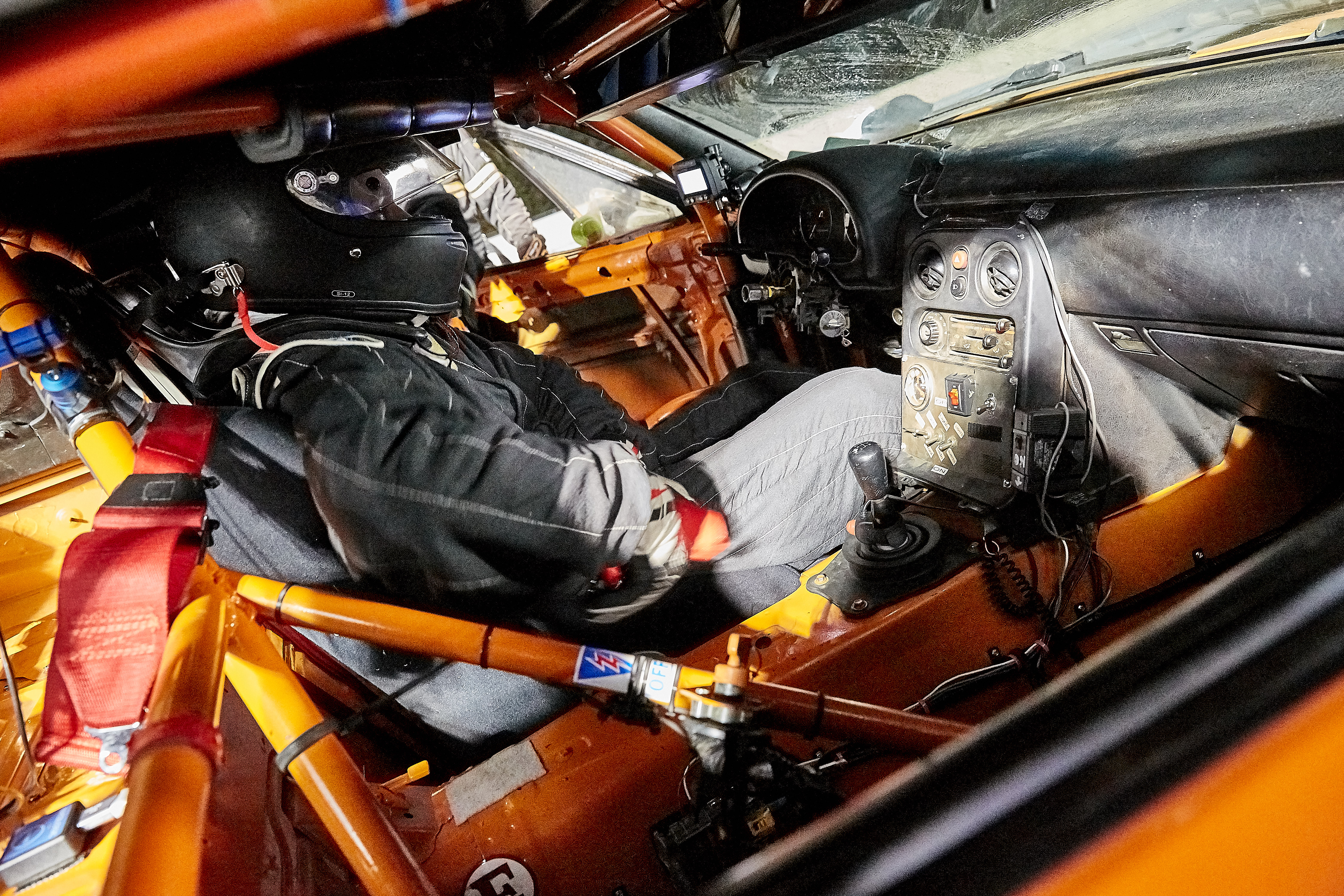
Brandon Fetch getting strapped in and comfortable. Well, as comfortable as a 6’3″ guy can get in a Miata. He would get us to the end and seal our 2nd in class finish, in spite of the car dying with 8 minutes to go.
After the final pit stop, we had our best driver in the car, but Brandon had decided to switch to slicks, since parts of the track were somewhat dry at this point. That proved to be a mistake, as he never got his times down under 2:00. It didn’t make much difference at that point as we were way too far behind the leader to catch them, and 3rd place (the only other car in our class still running) was far enough behind us that we were able to stay ahead of them.
Then, with eight minutes left in the race, the electrical demons had their last laugh, and the car died, completely, as Brandon was coming out of T5. We were the final caution of the race, but still finished 2nd in class, as there wasn’t enough time for 3rd place to make up the difference.
Once Brandon left pit lane, we had gone into pack up mode, clearing everything out of pit lane and back to the garage. We packed everything up as we watched the podium celebrations, and that was when I learned that Dan was still on his novice license! This was only his second official race, and I have to admit, I was surprised, because while Dan’s driving experience was brief, he has been on endurance team pit crews for years, and it really showed. I learned a lot from both Mike and Dan, and for that matter everyone else, and I wouldn’t hesitate to be team mates again.
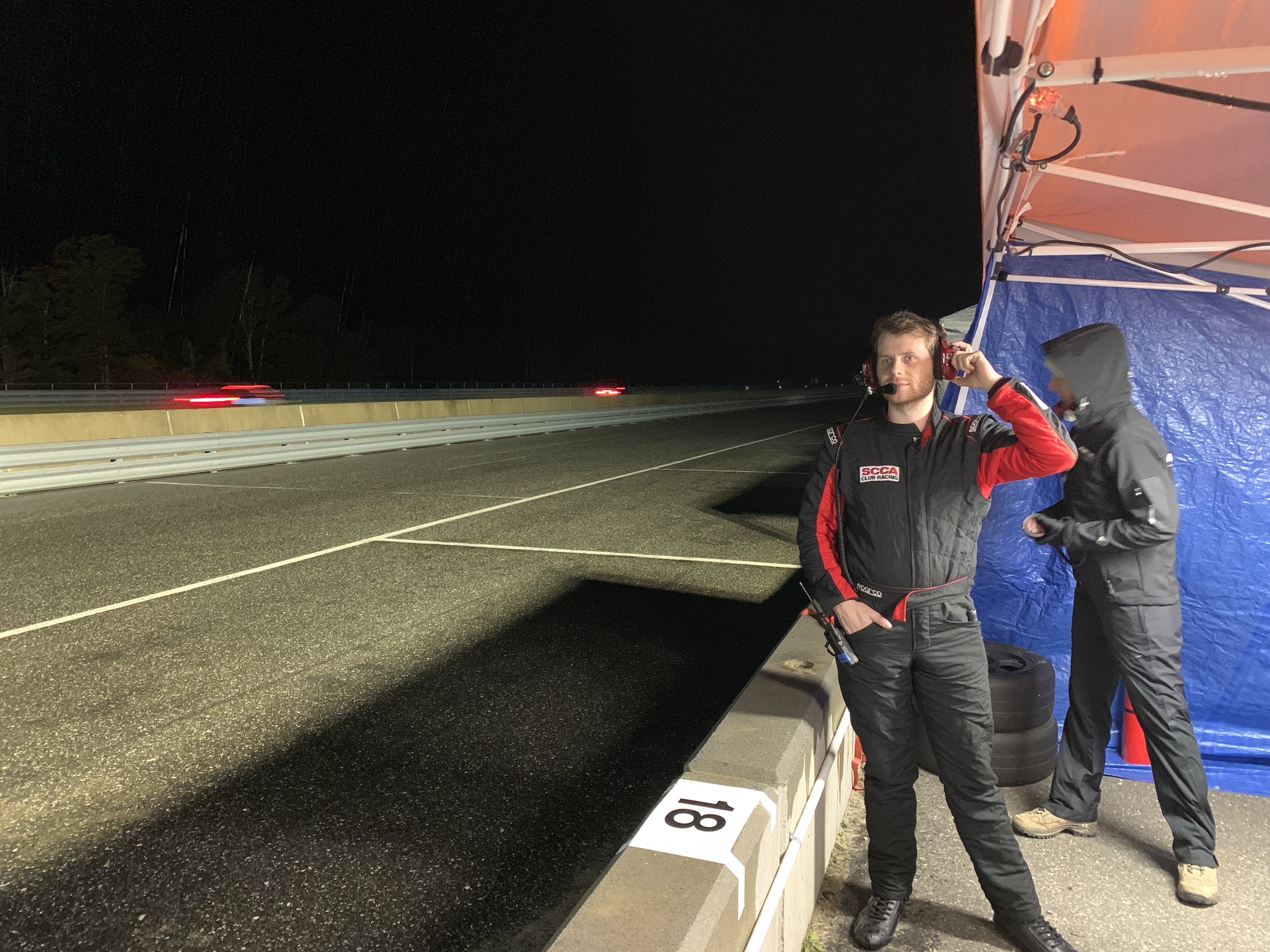
Dan Jensen monitoring the team radio during the night practice, Melissa Fetch standing just behind him watching the blur of race cars in the night.
Team NoRags finished 2nd in class (E5), and 20th overall, with the 10th fastest lap of the race. But one way in which we won the event overall was in the fun we had. There’s no doubt in my mind that we had as much or more of it than much better financed, staffed and prepared semi-pro and pro teams that we competed against.
Once we were all packed up, we headed out to one of the few restaurants open that late for what Marty referred to as the “Team NoRags 2019 Devil in the Dark Planning Meeting”. Everyone wants to do this again, and we all want to do more advance planning, including practicing pit stops, and just overall improving the way we function as a team.
This was easily the highlight of my fledgling racing career thus far, and now that I’ve experienced endurance racing, I will forever view sprint racing as nothing more than practice for enduros. I absolutely loved driving in the dark, and even in the wet conditions as well, and can’t wait to experience it again. I’m hoping to talk the team into maybe running an AER race in addition to the Devil in the Dark next year.
Left to right: Dan Jensen, Melissa Fetch, Kentaro Moore, Mike Qiao, and Mike Hontz. We’re admiring the efficiency and superior equipment of the pro team next to us. We might have been a ragtag bunch of amateurs and mercenaries, but we had as much fun as anyone else.
In closing, I also have to talk about one other thing that happened this weekend that was really special to me: my son Kentaro (everyone calls him Ken) joined us as pit crew, and got his first taste of road racing culture. I didn’t make a very big secret of the fact that I was hoping he would catch the bug we all have, and that turned out to be a huge success. When we got back home, for the next few days, this was all he would talk about. He wants to practice changing tires on my SM2, maybe even practice fueling, and generally wants to figure out how to make pit stops a lot more efficient.
When we were packing up the garage, Marty and I were talking about all the fun we had, and he asked if Ken was interested in racing, to which I replied: I’m hoping so! Ken walked into the garage a few minutes later, and when he took off the fire suit Marty had loaned him, Marty told him to keep it. That suit was his Dad’s, and giving it to Ken was something I’ll never forget, and always appreciate. Thanks again, Marty.
So yeah — I would LOVE nothing more than to introduce my son to this sport, and share all this fun with him. Ken and I used to close down go kart places when we were on vacation, and I remember that I didn’t always beat him. Now, I’m looking forward to 2019, and making this hobby a family affair. I’ve got a variety of great ideas for Xmas presents this year now….
This brings my 2018 racing season to a close, and I have more incredible memories from this year than any other I have spent on the race track. I got my full comp license, ran my first enduro, and introduced my son to something I am pretty sure he’ll share my passion for.
We’ll find out in 2019…
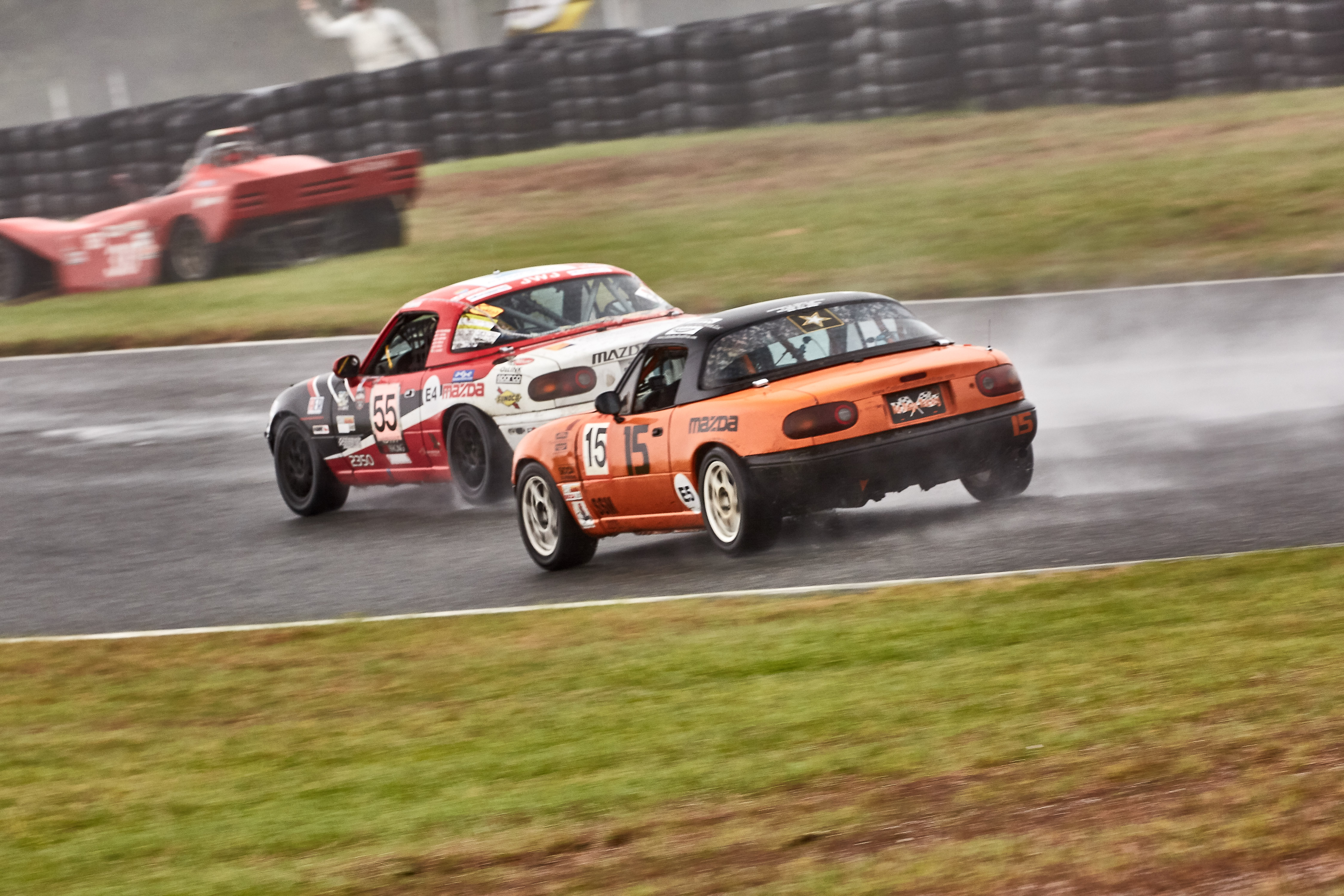
I’d like to say this shot is us catching the #55, but it’s most likely the tail end of us getting passed. Racing in the rain, and the dark, no longer intimidates me, not in the slightest.
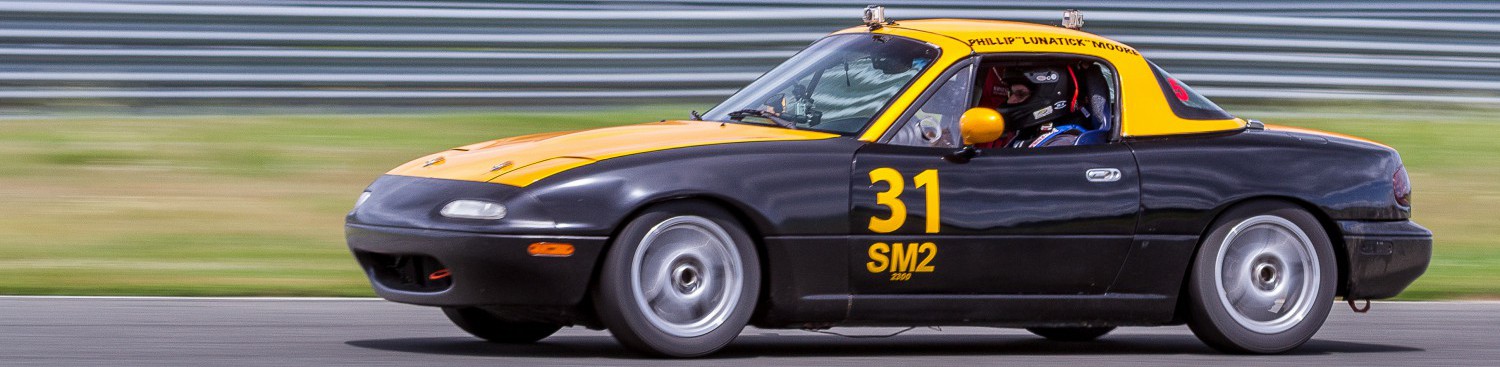
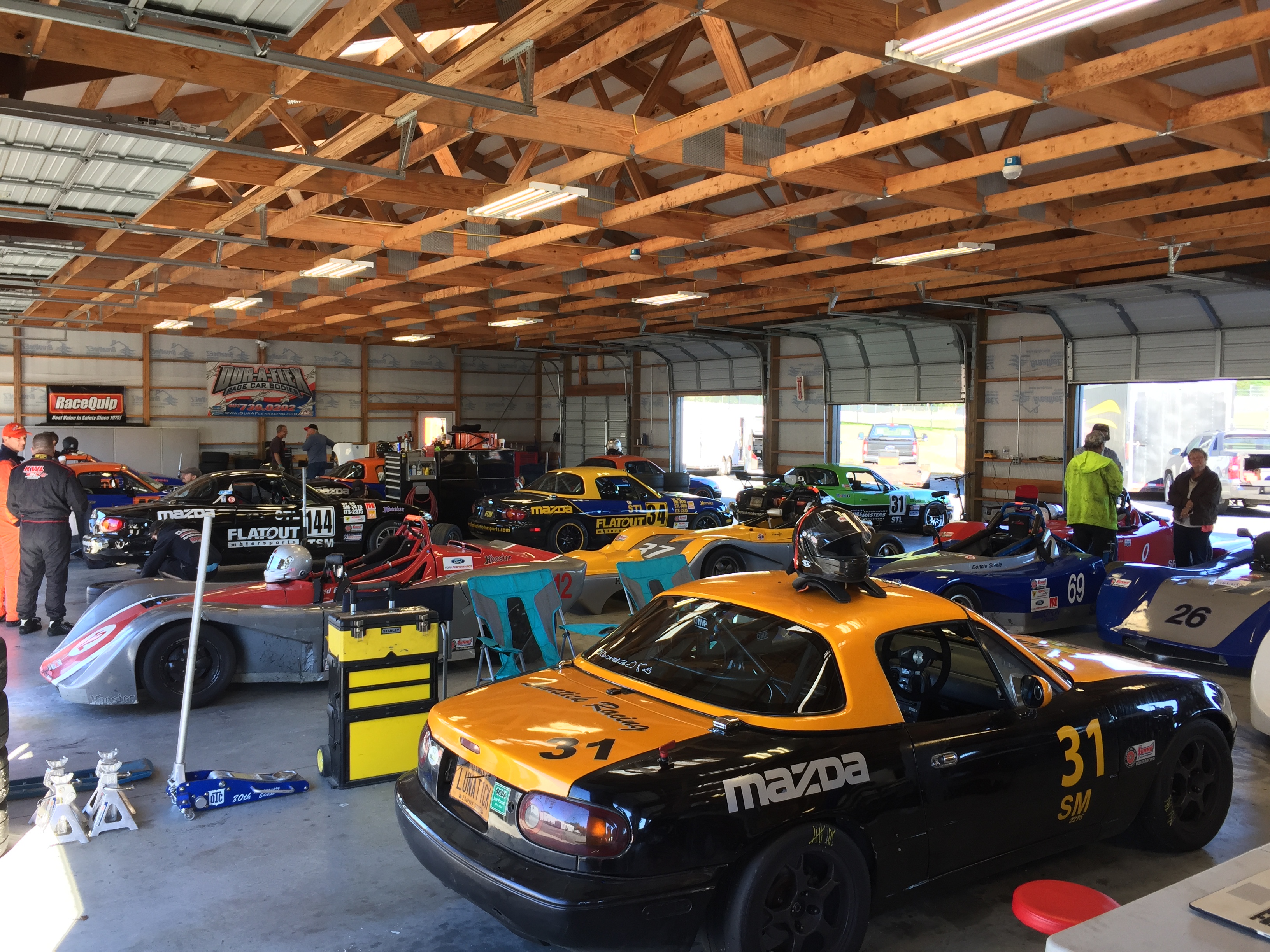
The Lunatick Racing #31, in the fun end of the garage, with the Motion Dynamics SRFs, and the Flatout Motorsports Miatas. Flatout made it easy to time the day — when there was a flurry of activity on their end, I knew it was time to go.
2018 has been a very good year for Lunatick Racing, as I finished the requirements for my novice license with a pair of races at Watkins Glen and Pitt Race, followed by my first races on the Full Comp license at Watkins Glen and Thompson Speedway. This report is for the latter race, which was also my first solo event, without my usual paddock mates to help with the inevitable problems and issues that arise.
Since this was the last event of the season, I decided to double dip and run in both Group 2 (SM) and Group 8 (SM2). The Thursday test day gave us five short sessions on track, every hour on the hour from 9AM to 1PM, since there was an SCCATrack Night in America event immediately after wards. The only thing bad about this was that it made calculating and measuring tire pressure a bit tedious, because the turn around was so quick, they didn’t fully cool between sessions. The car ran flawlessly all day, and I was able to reliably replicate some good low 1:27 lap times, which would only improve throughout the event.
Running in two classes meant four sessions each day. On Friday, there were a pair of qualifying sessions in the morning, with a pair of races in the afternoon, and Saturday had four races, two in the morning, two in the afternoon. I ended up running in five out of the six, and bailed on the final SM2 race, in order to avoid getting home exhausted at 2AM. It turns out the tow home is almost all freeways (well… they aren’t really *free* in the Northeast, but when you roll through all those toll gates using an EZ-Pass, it’s easy to forget how much $$$ is being sucked out of your bank account), and only took about 3.5 hours, including a pit stop for fuel and snacks.
This course had one very unusual hazard we were warned about during the driver’s meeting: turtles, and big ones that can end your event, or your year, in a very expensive manner. Apparently, when it’s warm, they like to run across the track for reasons known only to them, in the T9 to T11 section. In a Miata, you are flat out in 3rd gear going through T10, hanging on for dear life on the edge, and now you have to look for misguided, suicidal terrapins making a mad dash in front of you. Last year, at a vintage race, a big one (as in, a shell 2-3 feet in diameter) ran in front of a ‘vette, and all they found was the front legs, and a lot of shell parts. That means the rest of it was attached to the undercarriage of the destroyed race car, and someone, somewhere, has some truly disgusting photos of the post-event repair session that must have been required.
I am shocked to say that I was actually happy that it was a bit cold all three days. I never saw a single turtle, but I never stopped looking for the bastards when I turned into T9.
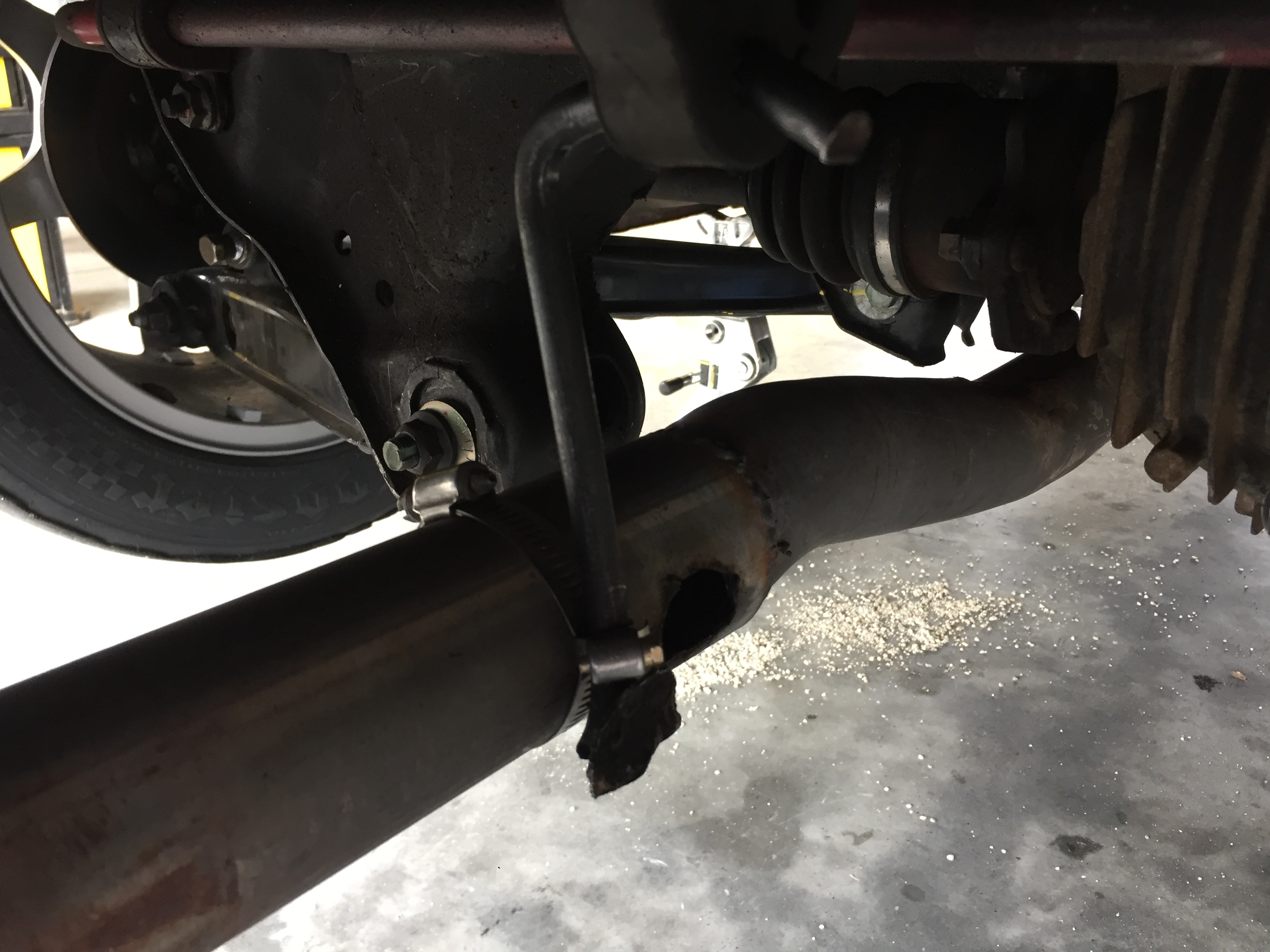
I am personally thrilled with how the weekend unfolded, as I never even put two wheels off track all weekend, ran consistent lap times, and got incrementally faster as the event went on. Plus, I managed to not hit or get hit by anyone or anything, which is always a bonus. By the end of the last race, I was able to put down mid 1:26s pretty reliably. I had the inevitable mechanical challenge, but it was minor compared to the headaches that tried to throw me off earlier in the year. The rear mounting bracket on the exhaust snapped off (failed weld), and I had to perform a guerrilla repair job using a pair of hose clamps. Worked perfectly, and I didn’t miss a single lap.
Good as new… well, for an old Miata anyway. That weld snapped, and the exhaust pipe started to really rattle around, so after scoring a couple of clamps from Matt Kessler and Mark Gregory, this held up for the remainder of the weekend.
The races were, as they almost always are, a ton of fun, although I didn’t get into the heated battles like I had at some of the other races this year. Not every event is going to be a dog fight, though, so you take what you get. I was quite happy to get through T1 on the starting lap of every race, because somebody got punted and spun, sometimes a group of cars, every single race. Part of this sport is driving smart and avoiding the carnage, and I managed to do just that. Two of the five races were run under double yellow after the starting chaos, but both of them did get restarted and at least finished under green. All of those experiences are worth something, and I learned from all of them.
The first SM race was somewhat uneventful, but the first SM2 race was a lot of fun as I chased a pair of slightly faster drivers and had a front row seat to the battle they were involved in. I just couldn’t quite catch them to get into the mix, but they knew I was back there. Watch G8-R1 to see #33 Rebecca Harvey and #06 Jeff Longo battle it out less than a second in front of me. That race was also run late in the day with the sun very low on the horizon, creating a special hazard as it was right in your eyes when you were at the apex of T10. And remember, that’s the turn that was the turtle hazard, so now, you weren’t going to be able to see the damn things until you hit a living speed bump and got an up close and personal view of the wall.
Saturday’s morning races were both run under full course caution for about half the allotted time, but both were restarted, for short sprints to the finish. That was the first time I had experienced a restart, as well. I only ran the first afternoon SM race, which was green from start to finish, and perhaps a slightly frustrating result. So many cars spun out in the morning SM race, that I wound up with a great starting position in the last one. However, that just means I was gridding in front of a bunch of faster drivers, and sure enough, I got picked off by the lot of them, one by one.
As I loaded up the car and got ready to head home, I was reflecting on what an fantastic event this was, and also reflecting on the year I had, and at that point, I realized that 2018 was the year I truly become a race car driver. Next year, I plan to run in enough of the NE Division races to qualify for the SM2 championship, and will almost certainly double dip at every event where SM and SM2 aren’t put into the same group (or, consider possibly running in non-SM classes as well).
I’m ending the season by running in my first endurance race, at the Devil in the Dark at NJMP on October 26-27, but not in my car. That’s less than 2 weeks from now, and I have never been more excited about a track event than this. It’s a 12 hour race, and we have a team of five driver’s and three crew (one of whom happens to be my son, who will be getting his first taste of road racing culture — I’m hoping he gets hooked :-), and we think we have a shot at a podium finish in E5 if we get our act together.
I’ll be sure to post video from that event, and a full write up on it, as it promises to be extremely fun and exciting, and will include a long list of racing firsts for me. In the meantime, here are the videos from all five races at Thompson, in both standard and 360 video formats. Watch the starts of races G2-R2 and G8-R2 to see all the lap one carnage, and G8-R1 to watch the #33/#06 battle.
I have been using GoPro cameras since the release of the Hero1, and have been using them to capture my time on race tracks for years. I’ve been constantly improving my setup and the way I use it, and embracing new features and functionality of the cameras as they become available. However, they are a means to an end. The end is creating high quality track videos that I can study to become a better driver. One of my goals is to make the entire process as minimally labor intensive as possible, so that I can focus on my car and my driving, and not have to waste time paying attention to the camera setup.
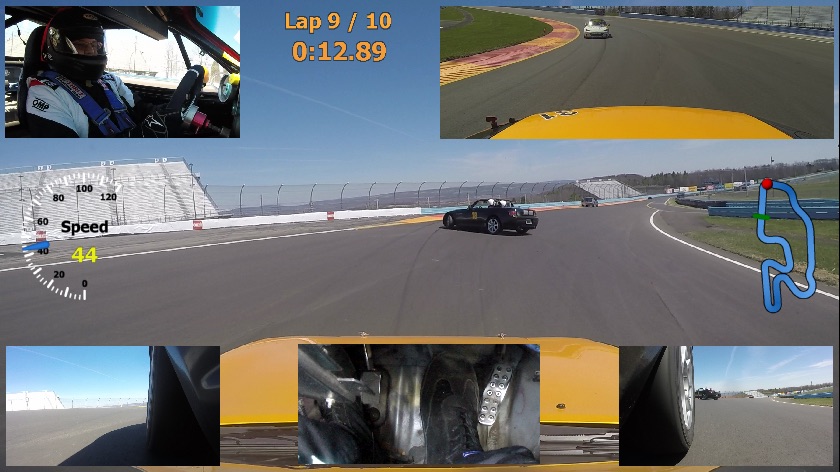
By the end of last year, I had a pretty reliable system for running four cameras on my car (front, rear, driver and pedal views), and I’ve even played around with running 6 (two additional front-facing cameras behind the front wheels). There were two main drawbacks to this setup, though: power and control. GoPro battery life has improved, but it has never been possible for me to get through a single day at the track without having to monitor the battery charge, and swap them out when it gets too low. Controlling the cameras was tedious, because I had to go through a pre-session ritual to turn them on and get them recording. So this year, I decided to upgrade the setup in the car to address both of these issues. When I bought the car in 2013, I had the shop install a USB hub which was made for the kind of environment inside a race car, and I ran USB cables to all of the camera mounting locations. I hadn’t really used it until now, because I prefer the camera views from roof-mounted locations, but I finally went ahead and drilled some holes to accommodate the power cables.
To address camera control, I decided to finally implement the use of the WiFi remote control. To do that, I had to have WiFI capability on all 4 cameras, so I purchased WiFi backpacks for my Hero2s, and purchased a couple of used Hero4s to round out my collection. The plan was to use my best cameras (3 hero4s and one Hero3) for this setup, with the Hero2s as a fallback.
The goal was to be able to get to the track, unload the car, mount up the cameras, power on the WiFi, and basically forget about them until the end of the day when I pack everything up for the trip home. All I would have to do is (a) power everything on with one push of a button on the WiFi remote, (b) power up the car, and then right before going on track, (c) start them all recording with the single push of a button. Complete and total automation.
The result has been nothing but frustration and disappointment, as I have uncovered one unexpected problem after another trying to make this work. Even more disappointing has been GoPro’s “support” for the one problem I did report, where their response to the inability to figure the problem out was to close and “resolve” my problem ticket.
To start with, WiFi connectivity between the remote and the cameras proved to be extremely flaky. When powering up the remote, normally all 4 cameras (assuming that they are powered off and the WiFI is on, of course — an issue I’ll come back to) will be detected and powered on within 10-15 seconds. That worked ONCE and ONLY ONCE the day at the track, and the other attempts only brought up 3 of the 4 cameras. Making matter worse, when I went to check to see which camera didn’t power on, I couldn’t find it because they all powered on, but only 3 of them were shown as “ready” in the remote. If I wanted to start recording, I’d have to get out of the car find the red light thats not flashing, and manually start the camera.
The Hero4s proved to be unreliable when running off of USB power as well, and two of the three Hero4s I used froze during the first session, and not only stopped recording, but corrupted the memory card. GoPro Quik was unable to recognize those cameras when later connected to my laptop, and it required formatting the card to recover them.
Since the pair of Hero4s could not be trusted, I swapped them out for a couple of my older Hero2s with the WiFI backpacks, but then discovered that while the camera battery will charge while it’s on USB power, the WiFI backpack apparently does not. Both of them were out cold at the start of the 4th session on track later in the day, and I had to revert to manually starting the cameras again.
My problems didn’t end when I left the track, either. The GoPro Quik MacOS X application, which I’ve been using to automate transferring the video from the cameras to my laptop, was also equally unreliable. Two of the four cameras could not be read properly, and they got stuck in the initialization phase, and I had to revert to manually copying the data files using the MacOS Finder as well. I had none of these problems with any of the previous releases, which had worked perfectly for at least the data transfer functions I used them for.
Prior to departing for this track day, I had spent a great deal of time testing out my new setup in my driveway, and I never had any of these problems at all. I did discover one extremely annoying difference in behavior between the Hero3 and Hero4s, though: if the USB power changes state while the Hero4 is powered off, it will have the side effect of powering off the WiFi. The Hero3 does NOT do this — it stays on, as you would expect. Until I rewire the USB hub in the race car to bypass the kill switch, that means I had to be very careful to be sure to power the cameras off (via the WiFi remote worked fine) before powering the car off, otherwise, the next time I tried to turn them on, the Hero4s would not be listening.
I reported that problem to GoPro, and had an completely unsatisfying experience with them. First, you need to understand that I’ve been working in the Enterprise Software space for my entire career, and I am used to providing detailed, verbose problem reports for the multi-million dollar products I support, and expecting high quality feedback leading to a solution to my problem. You know, “professional” support (you can guess where I’m going with this). I explained, for example, that I was able to reliably reproduce this problem only in the Hero4s, and I could reproduce it with just about any combination of USB power source or hub. I provided the technical product details for the hubs I used, as well.
GoPro’s “technical” response was pathetic. After some back and forth getting the derails clarified, the first thing they asked me for, after I had provided links to the product’s websites and technical spec sheets, was a *photograph* of my USB hub (and they only asked for photos of ONE of them, not the others). I refused, and demanded to know why, and never got an answer. A few days later, the support individual emailed to let me know that yes, GoPro engineers had agreed it was a problem.
Then they closed my ticket and resolved the issue. They gave me no means of finding out if they were even going to fix this, and if they were, when I could expect to see a fix available. They refused to answer any of my followup questions once the ticket was closed, as well. I just got no answer to the few emails I sent.
So, clearly GoPro’s idea of “support” shows that these are NOT “professional” quality products. No, they are, and always have been, “consumer” quality, and I am being painfully reminded of this. If I were to call them up and report each of the discrete issues I’ve found, I’d be opening up about 10 new tickets with them, but I have near zero confidence that they will treat any of them seriously.
I’m nearing the end of my patience with this company and their products. Everything I am doing is a documented, supported use of the product. Every single one of my cameras has been well cared for, and they are all running updated firmware. The end results, once I am done fighting with the cameras at the track, and then fighting with them again when I get home, is still worth the effort…. Or is it?
I do intend to find a way to bring this to the attention of someone at GoPro, and give them a chance to stand behind their products, but if they don’t, then I am not going to send them another dime. Based on the similar experiences of other users posting issues in various searchable forums on the net, I’d say the chances are good my days as a GoPro user are numbered and short. It might be high time to start giving their competitor’s products a serious look, or to simply get serious about investing in a set of *professional* quality cameras, most likely in the form of a motorsports-specific integrated data/video solution.
If you’ve spent any time at all on Facebook or YouTube, you’ve no doubt seen examples of the panoramic 360 videos that are starting to be more and more common. You used to need a very expensive specialty camera, costing thousands, or be willing to cobble together six GoPros if you wanted to play with 360 video, but over the last couple of years, some affordable consumer products have been hitting the market, making this cutting edge technology available to far more of us.
Last month, I decided the market was mature enough, and after a few days of research, I decided to buy the 360 Fly 4K camera. This particular device shoots 360×180 spherical video, and is a single-lens device, costing around $500 (I’m rounding up by a penny). Note that if you want to shoot “true 360”, it requires more than one camera, and given the fact that my primary interest is shooting videos from my car on the race track, that’s not really a requirement. Several of 360Fly’s competitors support cobbling together multiple cameras, but not the 360Fly. If that’s important to you, this camera might be the right one, but for me, it was perfectly adequate. True 360 also adds another complex processing step in the editing workflow, as you have to stitch the multiple video streams together into a single 360×360 video.
The device is very well engineered and comes in some packaging that would impress the folks at Apple. The camera is basically a ball just about 2 inches in diameter, with one and only one button, and a special magnetic docking station for charging and connecting the device to your computer. Included with the base product are the charging dock, and some mounting hardware. When I purchased all of this stuff via Amazon, I also bought the adapter which allows you to use your existing GoPro mounting hardware, but it turns out that was actually included as a base accessory, so you do not need to purchase it separately. The led provides feedback through colors and flashing, as well.
Setting up the device and working with its software, however, was not terribly impressive. I may not be the target audience for those applications, however, as they try to make it very easy to copy videos from your camera to either your smartphone or laptop, and then publish them to YouTube, Facebook or the 360Fly website. The smartphone application is also used to control the device remotely, for example to start/stop recording without physically touching the device, but since I have 8 cameras attached to my car (yes, I have gone a bit overboard) I’ve got a routine for turning them all on. What’s one more button to push? You have to use the smartphone app to configure the device, and I found it to be fairly clumsy.
For starters, the phone communicates with the device by both WiFi and Bluetooth, and be warned that if you find that you need to perform a factory reset and start over, you will need to be sure to tell your smartphone to forget about both the WiFi network and the Bluetooth connection, or you will struggle to get it reconfigured. This device is a relatively new hardware product, and that inevitably means that there will be firmware bugs. I encountered a couple of them, and had to perform several factory resets while getting the device setup the way I wanted, and it was not a fun process to perfect.
The settings matter, too. For example, by default, the device will shoot 4K video @ 24 fps and it is only with the slower frame rate that you can watch the video live on the smartphone. This is something I will never need to do, and since I shoot everything else at either 30 fps (29.97 fps, in reality) or 60 fps, I had to be sure I changed the default resolution. If you are NOT interleaving this video with any others, then the higher frame rate won’t in practice make much difference, but I am doing telemetry overlays and picture-in-picture, so using matching frame rates makes my life a bit simpler.
On your laptop, there’s an application (360 Director) for editing and uploading the videos captured from the camera, but it is primarily intended for users who don’t plan to do very much editing before they share things. The software has very minimal editing capabilities, and if you aren’t careful, you will run out of disk space in a big hurry. 360 Director’s data management is not very well thought out. There’s a single “database” file which contains all of the videos and photos you have uploaded, but when you edit individual videos, a backup copy is saved outside of that database. If you do not take care to manage this space, then multiple edits will produce multiple backup files, and these can be huge. This software can also be used to export your raw or edited 360 videos for use in other editing software as well.
I did not spend very much time with 360 Director as an editor at all, once I found out that the primary editing software that I use for my track days (RaceRender 3) can work with the raw 360 video directly. Since the camera acts as a USB mass storage device when connected to your laptop, extracting the videos you’ve taken is as simple as dragging and dropping, and there really is no need to use 360Fly’s software at all. This is important for advanced users who intend to use the raw video in more advanced editors, such as Final Cut Pro or Adobe Premiere (neither of which I own — I currently use Corel VideoStudio, which does NOT yet support 360).
The biggest problem I had initially was getting and keeping the device charged. Although a recent firmware update has addressed this, originally the device did not work correctly with Apple’s USB chargers, and guess what I own 100s of? Normally, I run two sessions on track in the morning, and then charge everything over lunch to get through another pair of sessions in the afternoon. The first 2 days I used the camera on track, it didn’t make it through the day, but this shouldn’t be a problem going forward.
Editing 360 video is a bit of a learning process, especially if you work with software that doesn’t fully support 360. In my case, since RaceRender supports it by default, there was really nothing special to do at all, and although I was prepared to struggle for days to figure it all out, it Just Worked. This is a huge credit to the RaceRender developers, who put out a very stable, feature rich and easy to use product. Be prepared to invest some time understanding the format and it’s limitations, if you want to do anything fairly advanced.
Uploading the videos to Facebook or YouTube took some experimentation to get right as well. You can’t just upload the raw 360 footage from the camera, as you will just “see” the raw spherical footage. The video has to be converted to an equirectangular format, with the appropriate 360 metadata embedded in the file, in order to be recognized as a panoramic video. I currently do not have a means of previewing the 360 videos on my laptop, either without trying to load the edited videos back into 360 Directory, and that produced incorrect results anyway — the video rotated around the wrong axis, but worked fine when uploaded to YouTube and then viewed via Chrome. This really is a leading/bleeding edge technology, so expect things to break, and be prepared to do some work to figure out why.
The end results are, however, pretty damn cool, and worth the effort. Now, I will admit that I do not find the format to be terribly useful for studying how good or bad (sadly, often the latter) I’m driving, but it sure looks cool and the videos are fun to watch and interact with. I plan to continue running the 360Fly along with the rest of my GoPros, and make the results available, but I’m undecided on the long term value of these videos, at least as a self-education tool for becoming a better driver. But damn, they look cool….
Here’s a lap around Monticello Motorsports Club in my Spec Miata, in 360. I pretty much had the course to myself that day.
One of the things I’ve learned over the last few years is what a very small, tight-knit community the world of racing is. Before I ran my first track event, I was worried that I’d be running into a lot snobby Ferrari owners, and arrogant rich guys, and while there are certainly a few (very few, actually) of those unpleasant types to run into, the reality did not meet my expectations. The people I met were mostly like me — people with careers who had enough success to afford a track toy, who shared a love for beautiful fast cars, and a passion for driving them the way they were intended.
I can think of no better example of the great people I met than Ian Prout and Elivan Goulart, President and Vice-President, respectively, of the Sports Car Driving Association (SCDA). I ran my very first track event with them at New Jersey Motorsports Park (NJMP) back in September 2011, got hopelessly addicted, and turned into a regular, making it to about 25 events with them through 2014.
While I suppose I was just another customer, both Ian and Elivan could see that I had caught this bug pretty bad, and they gave me a LOT of encouragement and coaching, and even let me sneak out on track during the instructor’s sessions when they weren’t very crowded, giving me even more time doing what I’ve come to love. In 2014, when I almost pulled the trigger on the racing school at the Last Chance Enduro at Watkins Glen, Ian even offered to co-drive my car in the 4 hour race. He wasn’t jerking my chain, either, we actually had several chats to plan it, but unfortunately, the timing wasn’t right. Although I ended up taking 2015 off, I did found Lunatick Racing LLC, and had worked out a deal with Ian to offer GoPro rentals at SCDA events, in exchange for a discount as a driver. We were even talking about a path to making me an instructor as my skills progressed.
Success in motorsports, at really any level, depends most critically on the people you get to know, and the connections you make, and there is no doubt that were it not for the encouragement and friendship of both Ian and Elivan, I would not be having the fun I am today, just a few months away from finally getting my competition license, and getting to race for real. In my fantasy racing career, I always pictured myself winning my first race, and giving a shout out to both of these guys, without whose help and support I wouldn’t have been standing there holding the checkered flag I dream of one day taking home.
And so, when we all heard that we had lost Ian, to say it was shocking would be a terrible understatement. In just his early 40s, and one of the nicest guys I have run into in this community, it was hard to believe that he was gone. Just a few days before, we had been exchanging emails as I was planning out the season’s events, very much looking forward to hanging out in pit lane to talk racing, as much as being on track. Facebook lit up with responses to the original announcement, and at the two track events I’ve attended thus far, people who knew him (which seems to be just about everyone in the Northeast) were just horrified.
I missed the season opening event with the SCDA this year, and I really wish I could have been there to show my support for Elivan and Co, and help to remember Ian. Elivan has taken over as President, in what has to be a horribly bittersweet “promotion”, and the community that is the SCDA will keep on going, but Ian’s absence will forever be felt, I’m sure. Elivan had some great “Never Without Ian Prout” SCDA stickers made, and I’ve asked for a couple to be set aside for me. I don’t think I will ever set foot on a race track again without remembering Ian, and I’ll try to remember him with smile.
But right now, smiles are kinda hard to come by, the pain of his loss still raw, the memories still fresh of the man we remember. The best thing we can all do is to remember, and never forget, what it was about Ian that made us like the guy so much, and perhaps try to find those qualities in ourselves, and be better people as a result.
Whatever you may believe about life after death, there’s no doubt in my mind that someone’s spirit lives on as long as we remember them, and celebrate them. I won’t forget Ian, and I’m sure that not a single person who knew him will either.
I’ll remember him every time I strap myself into a race car, fire the engine up and feel that rush of adrenalin.
NOTE: Links to three full session track videos, and one amusing highlight involving the death of the T1 track out cone and one of my GoPro cameras are at the bottom of the post.
This month, I made my second trip to Watkins Glen, and participated in my first HPDE event with a new-to-me organization, Chin Motorsports. I’ll cut to the chase and just say up front that this is the most professionally run HPDE event I’ve ever attended, and for several reasons, a group I very much look forward to running with again in the near future. Plenty of track time, great staff, and most importantly for me personally, they allow anyone to give rides to passenger’s. I’ll come back to that last point later on.
I arrived the evening before the event to get unloaded and get the car inspected, and got to meet the staff. I also signed up for a checkout ride so that I could get into the non-novice run group. When I signed up, I was put into the Green run group, which includes both novice drivers with instructors and what they call “provisional solo” drivers. Although I have a LOT of track experience, since this was my first time running with Chin, and since I only had 4 track days when I signed up (days 5 and 6 were with Hooked on Driving back in April), they wouldn’t automatically put me into the higher run groups. I suppose some driver’s would be irritated by this but I both understand and respect the decision. Especially at a track as unforgiving as Watkins Glen, where mistakes are going to cost an awful lot.
Having unloaded everything Sunday evening, the morning of the first day was pretty relaxed, when I’m normally rushing to get everything out of the truck and setup before the first session starts. Chin gives you a total of six 30 minute sessions through out the day, although the first one is considered a warm-up, with no passing allowed. The 2nd through 5th sessions of the day are dedicated to each run group, of which there are only 3: Green (Novice and provisional solo), Blue (Intermediate) and Red (Advanced). The final session of the day at 4:30 is open to all three run groups. That’s a total of three hours of track time each day, 2.5 if you discount the warm-up session.
I did go out in the warm-up session, just to get some heat into the tires, so I could get my pressures set. I drive on Toyo Proxes RRs, and like to get them as close as possible to 38 psi hot. With a few drivers interpreting “warmup” as “parade laps”, it was hard to get up to speed, but it is what it is. The first real session I spent with the novices, and I think I caught every single car in the turns in my Miata. I wasn’t expecting to put any blistering lap times down, and just focused on my heel/toe shifting, and tried not to be an asshole by climbing up the tail pipes of slow Corvettes in the bus stop (there were several).
Since I had time, I sat in on the first novice classroom session, and was very impressed as well. The instructor had a great presentation that included lots of video examples of doing things both right and wrong. This was easily the best prepared class I’ve seen, but I can’t really compare it to others, since I normally don’t sit in on those. This is obviously a great organization for novices as well as experts.
For the second full session, I was scheduled to go out with an instructor to be checked out for the Blue Group (Intermediate). This was the first time I’ve had an instructor in the car in a very long time, and it reminded me that I would benefit from this kind of coaching. Although I “passed” the checkout ride with flying colors, and in fact was told I qualified for Red (Advanced), that would require another checkout ride in that group later in the day. I got some great feedback and tips on improving my driving technique as well, and it’s clear I really need to get some coaching if I’m going to take this to the next level. There’s a limit to how much you can teach yourself, and I’m close to reaching it.
Now, I was going out of my way to be polite on track, but every time I backed off going into a corner, he kept telling me “Get up on his bumper!!”. The fact is that my Miata, when pedaling really hard, is hard to catch in the corners, and for a lot of big heavy cars, hard to get away from. I totally confess to getting a rush out of annoying people in very expensive cars who are slow in the turns.
When we finished the checkout session, I was impressed with the attention to detail in Chin’s record keeping. He filled out an evaluation form for me, at this track, qualifying me to be in the Blue group, which we both signed, and they keep on file. Had I gone through with the Red checkout, we would have gone through that again. All the other groups I’ve run with were pretty casual about this, but I like how Chin sets the bar high for getting into the intermediate and advanced run groups.
I spent the rest of the day in the Blue Group, and was planning on getting checked out for Red the following day but the weather and conditions were terrible, so I stayed in Blue. I was even honest with the instructors, and admitted to getting a rush out of catching people in the turns, and they agreed that was a big part of the fun.
The first day was fantastic, and I managed to turn several 2:24s, almost a FULL three seconds faster than when I was here last month. When I really nailed T1, predictive lap times suggested I was running lo 2:23s, but I never got a chance to finish one of those laps without letting someone by and losing some time. In the hands of a really good driver, I think my car can probably do 2:19s or 2:18s, so I have a ways to go, but I’m getting there.
Day one did provide a very amusing highlight. On the last lap of the 4th session, I finally hit that track out cone on T1, but it managed to take one of my GoPro cameras with it. The WGI crew wouldn’t let me go look for it but they fetched it for me when the track went cold, and the short highlight video is kinda cool. Personally, I think the cone was in the wrong — track rules say I am NOT off track as long as I have two tires on the painted curbing, and the cone was too close. You can judge for yourself — watch the video.
Day two kinda sucked, as the skies opened up and the track was damp for most of the day. I don’t have a lot of experience in the wet, yet in my OUT lap in the first session of the day (I skipped the warmup), I hit the chicane going only about 65, but did NOT stay off the curbing, got sideways and spun, throwing dirt and mud all over the track. WGI is really babying their new, mega-buck repave, and we lost about half of that session while they cleaned things up. So, to all the other Blue Group driver’s, yeah, I was that asshole, sorry. I personally apologized to the Chin staff, as well, which I think they appreciated. I want to earn the respect of other driver’s, more than anything else, and not be That Jerk who screws things up. I own my mistakes as well as my successes.
The rest of day two I spent focusing on my shifting, and never really got to run that fast, plus someone blew up and put oil all over the main line in the early afternoon, making things really treacherous, so I called it an early day and blew off the last all-hands session to get a head start on the 3+ hour drive home. While I was packing up, the guy who had been riding along with one of the novices all day, who I assumed was his instructor, comes over and asks, “So, do you ever give rides?”. Um, no, I’m not an instructor, but…
And that was how I found out that Chin allows ANY driver (provided they are solo-qualified) to give rides to passenger’s, provided they sign their life away and sign a waiver. Of course, this is well documented on their website, which I thought I read, but, um, yeah…. This is a VERY big deal, because while I usually attend these events alone, I’d really like to bring my wife along, so she can enjoy this whole experience, too. Most of the HPDE organizations I have run with allow ONLY instructors to give rides, so this is a huge plus for Chin. While I am targeting reaching instructor status in the coming years, this will give me a lot of incentive to run with Chin again, and bring my wife (who is the entire reason I am into this hobby — separate story…)
Since I am trying to get to WGI as often as possible this year, and since we bought tickets to the Indy Car race there labor day weekend, I’m really hoping that WGI allows Chin to keep the two days they had reserved, which are the day AFTER the Indy Cars run there. That’s up in the air still, but if that event is run, that would be a dream weekend — watch the return of Indy Car to WGI, and then drive the track!!
I can’t recommend Chin Motorsports highly enough — great people, and great organization, and they are nationwide as well. I will most certainly attend more Chin events at this, and other tracks, in the coming years.
Here’s the video links, as promised. The first one’s very short, and the others are the complete session. Note that these all 4K HD videos, so find a good internet connection to watch see WGI in it’s complete, full glory!!
NOTE: Links to the two track videos from this event are at the bottom of the post.
This past Monday and Tuesday I had the pleasure of attending my first event with Hooked On Driving Northeast at Watkins Glen International. We were the very first HPDE event to run on the fresh new pavement, and while WGI was already my favorite track, it is even better and more gorgeous than before. I am particularly fond of the unique and unusual colors they picked for the curbing.
After taking last year off, since my wife and I bought a house, and my job situation was not entirely stable, I’m getting back into this hobby full time in 2016, and plan to get on track every 3 or 4 weeks. This addiction must be satisfied, and I don’t have to explain that to the other people who suffer from it. But if this is suffering, chain me to the wall, and torture me!!!
For this first blog post to revive Lunatick Racing, I’ll review the entire HoD experience, since this was my first time running with this organization. I heard good things about them from other drivers that all proved to be true: HoD puts on a great event, and the format is a bit different from other HPDE events I’ve driven. Most of my track days have been with the SCDA, but I have also run with IMG once, and done a few open track day events and some private member events as well. HoD splits up the drivers into 4 groups: A (novice), B (intermediate), C (advanced) and D (instructors and racers). The groups run separately in the mornings sessions, but were grouped together to give us slightly longer sessions in the afternoon. The two morning sessions were 25 minutes long, but the afternoon joint sessions were 35 and 40 minutes each. The first combined session was Groups C and D, and the second one was Groups B and C.
Passing rules for Group C were simple: passing allowed anywhere, with point-bys required. Group D, which is all race-prepped cars, has completely open passing, and I am hoping to get moved into this group for my next event. I drive a 1.6L Spec Miata race car, and I finally plan to get my comp license this coming August and get into endurance racing. Regardless, Group C was a LOT of fun. Passing in the turns can be a bit unnerving for inexperienced drivers, but HoD has gone a very good job of assigning drivers to the appropriate group, as I saw only one or two questionable moves during the entire 2 day event, and there were no incidents. As a Miata driver, I’m used to giving lots of point-bys to high HP cars and then climbing up their tailpipe in the next turn, so being able to get a point-by going into the turns was a huge win for me.
Running in the combined groups was going to lead to crowded conditions on track, or so I thought, but that did not turn out to be the case. In the C/D combined group, no one held anyone up, and I actually ran my fastest, unmolested laps in those sessions. In the B/C combined group, things were a bit different, as you can typically expect intermediate drivers to not be quite as aware of the cars behind them, but generally speaking, that was a very smooth session as well. My ego also enjoys passing slow drivers in big expensive fast cars that should eat my Miata for breakfast, I will have to admit. (My apologies to the slow Ferrari driver that I make fun of in the 4K video — I couldn’t help myself)
My only criticism of the event was due to the confusion at the start of the first day. We were told there would be 2 standing yellow laps for the first session, but then after the first lap, the guy in the pits waves the green flag, while all the flagging stations on track were displaying double yellow. Also, as I was about to roll onto pit lane, someone leans into my car and says “2 by 2 something something yada yada” and walks away. I found out later we were being asked to drive 2-wide down the front straight for a photo/video opportunity. I don’t think ANYONE understood that, ’cause we all rolled by single file. Honestly, other than that minor bit of confusion, I have no criticism of the way the event was run.
Lunch was provided, and was adequate, but I have to admit I lose interest in food at the track. It’s just another form of race fuel, and I’d eat granola bars all day just to avoid getting hungry. That is, I could care less how good the food is, just feed me so I can stay at the track all day.
In the 3rd session on day one, I had a minor brain fart after I spun going into T1, and I didn’t pit like I damn well know you are supposed to. Honestly, I have no explanation or excuse for this, but the result was that I got black flagged. That’s in the 1st track video I’m posting, and I turned it into a public service example of how NOT to behave on track. I also managed to NOT see the 1st two black flags thrown at me, since I was dealing with passing cars when I rolled by the flagging stations, and for that I was told if I missed them again, I’d be asked to leave the event. Morals of the story: (a) don’t be an asshole like me and not pit, and (b) pay VERY close attention to the flagging stations.
Also, always remember that most of the people at those flagging stations are volunteers. Only a few tracks have full time, paid professional crew, and most HPDE events you attend will have a lot of local volunteers working those stations. They are there to keep YOU safe, so show them some love and respect. I always go out of my way to acknowledge them, and everyone else should as well. They are in many ways the unsung heroes of the track and racing world, so let them know you appreciate what they do.
There was supposed to be a track walk Monday evening, but the Glen staff were photographing the track and took forever, and like many folks I got tired of waiting and split before it was held. I’ve done track walks of WGI before, so I didn’t particularly feel it was essential, however if you have NOT done so at any track and have the chance, it would have been worth the wait. I highly recommend taking advantage of those opportunities when they are offered. Most HPDE groups don’t do them, in my limited experience.
Day Two started out cold and wet, and I skipped the first session. In fact, it was STILL cold and damp for the 2nd one, and I made the worst judgment call of the event: skipped that one, too, and I am honestly embarrassed to admit it. In retrospect, I wanted to wait until the conditions were better so I could push harder than I did on Monday, but at my experience level, I need to be taking advantage of ALL available track time, regardless of conditions. I will not make that mistake ever again, trust me.
The 3rd and 4th sessions of the day were warm and sunny, and this fair-weather wimp went out for the most fun of the entire event. I chased my garage partner’s E30 around the track for a few laps, and managed to run some pretty consistent 2:28s, even though I only feel like I’m going at 90%. I see where all the time is to be had, and can’t wait to come back and lower those lap times, but I have to admit: The Glen, with its minimal runoff, is one hell of an unforgiving track, so I will be taking tiny little bites as I push closer and closer to 100%. I love this place, but it scares the hell out of me. In a good way.
This was also a chance for me to do some experimenting with the GoPros I use. I bought 4 of the new HERO cameras with the intention of offering them for rent (still hope to find an opportunity to do so, but its not a priority right now), and I picked up a HERO4 just last week so I could start playing with 4K video. I usually run 4 cameras (Front, Back, Driver and Pedals) but with all this extra hardware, I put a pair of them right behind the front wheels, and ran with 6 total. The 6 camera video suffers a bit from information overload, but it is VERY cool, since you get to see exactly where you hit or miss the apexes, and exactly where you track out. I came close to kissing that cone at the T11 track out on every lap, or I tried to.
I had planned to capture 4K video for the entire event with the front-view camera (which is always the main view in the composite videos), but like an idiot I did not realize I had it set to 1080 until the very last session. But, the last session was the best one, and I managed to get my 4K video to work with. I’ve been waiting literally years for all the pieces to fall into place so I could do full 4K, and the result is…. well, you can judge for yourself. The detail is incredible, and the results are just gorgeous.
So, in conclusion, I have to rate Hooked On Driving very, very high. I am looking forward to running at least one more event with them this year, since they do a lot of weekends and it will be easy for my wife, Ivy, to attend them with me. She is, after all, the one that got me into this, and continues to encourage me to play race car driver. Now is that a recipe for a happy marriage, or what?
As promised, here are the two full session videos I made, one from each day. The first is just 1080p, but the second one is 4K in all its gorgeous glory.
Finally!! I’ve been talking about doing this for the last couple of years, and have finally pulled the proverbial trigger. Hopefully, I don’t shoot myself in the foot in the process.
Lunatick Racing LLC will be created shortly, and I’ll be using this site to blog about my experiences in HPDE, Amateur Road Racing, and all the technical aspects of video and data in the context of the sport. While I have no plans to quit my day job, this company will be my way to get more involved in road racing, and motorsports in general, as both a driver as well as a videographer.
Once we’re fully up and running, this site will really come to life, so stay tuned…

 Lunatick Racing